

For all the physical challenges the expedition offers, its true centre of gravity lies elsewhere.
Every year, the journey leads the group to Torreciudad, the Marian shrine overlooking the reservoir of El Grado in Aragón. What began as a convenient meeting point gradually became the spiritual heart of the entire expedition.

"People often ask why we keep returning to the same place," says Antonio Irastorza. "The answer is simple. My own visits to Torreciudad had always been inspired by pilgrimage and devotion to Our Lady. As we explored the surrounding countryside, we realised that the area also offered exceptional opportunities for hiking, canyoning and mountain sports. It was the perfect combination of physical adventure and spiritual renewal."
For many participants, the visit to the shrine has become the defining moment of the week.
The expedition traditionally concludes at Torreciudad, where the group gathers wearing the distinctive navy-blue Lions polo shirt. Together they sing the Salve Regina, followed by the expedition's own anthem—a tradition that has become one of the most anticipated moments of every year's programme.

The music of the shrine's celebrated organ provides an unforgettable backdrop, lending a sense of solemnity that contrasts strikingly with the exhilaration of the previous days spent navigating mountain rivers and rugged peaks.
Faith in an International Community
Although Marian devotion forms an essential part of the expedition, Irastorza is keen to emphasise that the group has never been defined by religious uniformity.

"Not everyone who joins us is Catholic," he explains. "Over the years we have welcomed Anglicans, Orthodox Christians, Protestants, Jews and participants with different religious backgrounds. Yet everyone takes part respectfully in the visit to Torreciudad, and everyone appreciates the atmosphere of peace that the shrine offers."
That openness has become one of the expedition's distinguishing characteristics.
Participants are never expected to conform, yet many find themselves drawn into conversations about faith, ethics and the deeper questions of life with a degree of honesty rarely encountered amid the pressures of professional life.
Each morning, before the day's activities begin, there is an opportunity to attend Holy Mass.
"What continually surprises me," says Irastorza, "is that despite the previous day's exertions, and despite the inevitable lack of sleep, many participants choose to get up early to attend. Nobody is obliged to do so. They simply want to."
During the long drives between mountain locations, conversation often gives way to quieter moments.
Extracts from the writings of St John Henry Newman, reflections by the Pope, and passages from the works of St Josemaría Escrivá are sometimes read aloud, offering participants an opportunity to reflect before the day's next challenge.
For many, these moments become every bit as memorable as the sporting activities themselves.
Nature as a Place of Reflection
One of the expedition's enduring attractions lies in its deliberate simplicity.
There are no conferences.
No presentations.
No networking sessions.
Instead, participants spend hours walking through forests, climbing mountain trails or descending narrow canyons carved over thousands of years by fast-flowing water.
The landscape itself becomes a teacher.
"For many of us," Irastorza reflects, "the pilgrimage is first and foremost an opportunity to thank Our Lady for another year. For everyone else, regardless of faith, being immersed in nature becomes an invitation to reflect on life. The mountains have a remarkable way of restoring perspective."
The physical effort also plays an unexpected role.
Shared challenges dissolve professional hierarchies with surprising speed.
A managing partner may find himself relying on the encouragement of a young entrepreneur while negotiating a difficult descent. A chief executive may discover that success in the mountains depends less on status than on patience, teamwork and mutual trust.
It is precisely these shared experiences that transform acquaintances into lasting friends.
Beyond the Mountains
Although the Pyrenees provide the expedition's spectacular setting, the programme extends well beyond outdoor adventure.

Each year the journey begins in Barcelona, where participants spend a day at IESE Business School, one of Europe's leading business schools and an institution with which Irastorza has enjoyed a long association as an alumnus.
The academic sessions introduce an intellectual dimension to the expedition, encouraging participants to reflect not only on professional leadership but also on ethics, responsibility and the human dimension of business.
It is a fitting prelude to the days that follow.
Discovering Aragón
The expedition also celebrates the rich cultural heritage of the region.
Traditional Aragonese cuisine features prominently, with participants sharing leisurely lunches and dinners showcasing local produce and wines.
One favourite destination is Frutería El Vero in Barbastro, a historic establishment closely associated with the Albás family, relatives of the mother of St Josemaría Escrivá.
The group also explores the historic town itself, whose importance extends well beyond its medieval streets.
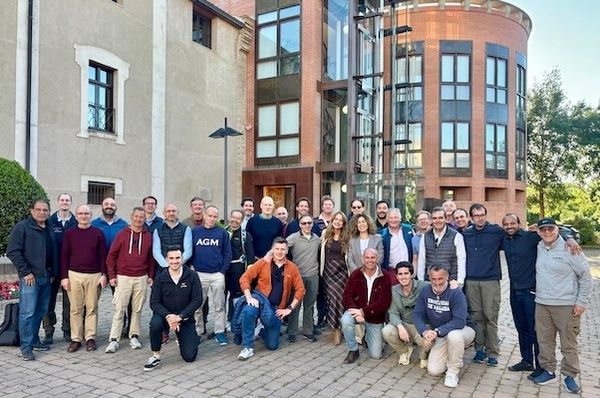
During this year's twenty-fifth anniversary expedition, the Lions were officially welcomed by Fernando Torres, the Mayor of Barbastro.
Congratulating the group on reaching such an important milestone, he praised their remarkable consistency over a quarter of a century and encouraged them to continue promoting the region internationally.
The expedition also visited the headquarters of the Somontano Denomination of Origin, whose wineries have become internationally recognised for producing some of Spain's finest wines.

These encounters reinforce one of the expedition's broader ambitions: not merely to enjoy Aragón's natural beauty, but also to support and showcase its cultural, historical and economic heritage.
By the time participants leave for the mountains, they have already gained a deeper appreciation of the region they are about to explore.
It is an experience that combines intellectual curiosity, cultural discovery, physical challenge and spiritual reflection in proportions that few organised journeys could hope to replicate.
In Part III, the article will conclude with the personal stories of several Lions—from Moldova, Poland, London and Madrid—whose testimonies illustrate how an expedition that began as an act of friendship has become an international community shaped by trust, resilience and shared values