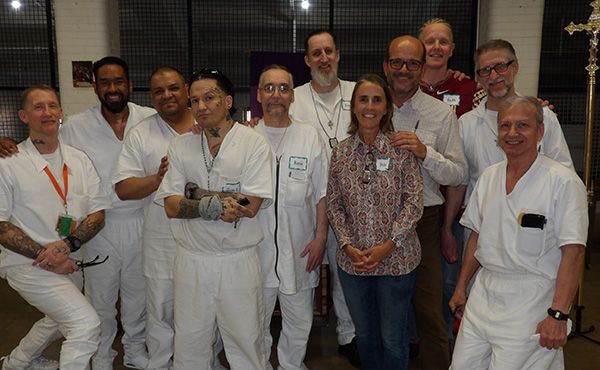
For some time, my husband and I had wanted to visit the Wynne Unit, a maximum-security men’s prison in Huntsville, Texas, near our ranch. For a long time, it was beyond our capacity. Our youngest son still lived at home, he was not yet old enough to enter the prison, and a trip there would mean leaving him home for an entire day. We wondered if the right time would come.
Then one Christmas, a snowstorm stranded both our youngest sons in Chicago, where they had gone to visit our oldest. Suddenly free, on Christmas Day we improvised and drove to the prison with Robert, an extraordinary minister of Communion from our parish who visits the men there. We were not on the gate list, but the warden knew Robert and let us in. After a moving visit, the men asked as we were leaving, “Will you come back?”
I came home eager to return. Nevertheless, I began to pray about whether God truly wanted this of me. As a wife and the mother of six grown children, my years of work had been with women, couples and families. A prison was not my natural environment.
Two weeks later, one day after Mass, Robert handed me some papers. Among them was a newsletter from St. Benedict’s Abbey in Atchison, Kansas, for its Prison Oblates – incarcerated men who, though not monks, live by the Benedictine Rule. The newsletter opened with a quote from The Way: “If you feel the Communion of Saints – if you live it – you will gladly be a man of penance. And you will realize that penance is gaudium, etsi laboriosum, joy, in spite of its hardship. And you will feel yourself ‘allied’ to all the penitent souls that have been, that are, and that ever will be.” The newsletter went on to announce that “Joy in spite of hardship” would be its motto for the year. It also explained who St. Josemaría was, described what Opus Dei is, and recommended three of his books – The Way, The Furrow, and The Forge.
I could not believe what I was reading. As a supernumerary of Opus Dei, I was overcome with emotion to see the Benedictines featuring St. Josemaría. I knew it was no mere coincidence. The answer to my prayer had come, loud and clear: Yes, I should go to the prison, and I should bring the spirit of Opus Dei with me. After all, the ordinary lives of those men unfold within those walls, and that is precisely what they are called to sanctify.
Soon after I read that newsletter, my husband and I were visiting the prison again. It was a Sunday, and after the liturgy, I gave one of the men, Marco, a prayer card of St. Josemaría. It turned out that he already knew who the Spanish priest was, and he introduced me to another prisoner – a young man also named Robert – who had just been confirmed inside the prison and had chosen St. Josemaría as his patron saint. This Robert wanted to learn more about Opus Dei. He had written to an address in San Francisco that he had found online, but he had not heard back yet. I told him I could tell him more about the Work, and since I was leaving for Rome in a few days, I promised to pray for him at the tomb of St. Josemaría and bring him something from there.
The following day, my husband received word from a numerary in the Bay Area, asking if he knew someone in Texas who could visit an incarcerated man who had written to them from Huntsville. That inmate was Robert. To everyone’s astonishment, my husband answered that I had met him only the day before. I kept my promise and prayed for Robert at the tomb of St. Josemaría in Rome. I brought him back a blessed medal. By then, he had been transferred to another prison, but once I found where he was, I mailed him a letter and the medal. He wrote back a long letter saying he believed my prayers had made a difference, because every transfer he had endured had gone unusually smoothly.
I have thought often about how quietly God arranged all of it: the snowstorm that sent us to the prison in the first place, the newsletter placed in my hands, the motto chosen for the year, a prisoner who had taken St. Josemaría as his patron without ever having met us. None of it was our doing. We had only said “yes” to a Christmas visit, and God did the rest. That is how He answered the prayer I had hardly finished asking, and it is why we kept going back to the men who were waiting. And waiting for us too, every time, was gaudium, etsi laboriosum – joy, in spite of every hardship.