
Oct 2, 2026 marked the beginning of the first year of immediate preparation. The Centenary celebration itself will run from Oct 2, 2028, the 100th anniversary of the foundation of Opus Dei, to Feb 14, 2030, the 100th anniversary of the beginning of the Work with women. It will be one celebration with two dates, expressing the unity of Opus Dei.
More than a birthday, the Centenary is meant to be a time of gratitude, conversion and renewed apostolic energy. The question guiding the work in East and South Asia is a simple one: how can we better serve each person, the Church and society through the charism of Opus Dei?
A regional committee with local ears
East and South Asia is a vast and varied region with multiple languages, cultures and social realities. From the beginning, it was clear that preparations could not be directed by one central team working from a distance.
The regional centenary committee is therefore organised as a small core team and a few local teams. Each local team has about five or six members, women and men with different backgrounds and experience.
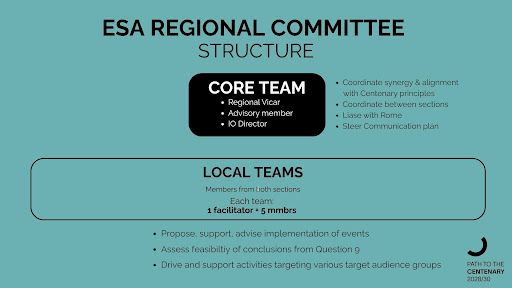
A small core team works with local teams so that preparation stays close to the realities of each place.
The core team - made up of the regional vicar, a director of the Regional Advisory and the director of the Information Office, keeps an overall view, remains in contact with the international committee in Rome, encourages communication between countries and supports the local teams.
The committee’s role is not to design a fixed programme or organise every event. Its task is to listen, connect and act as a catalyst: to help people understand the centenary’s spirit, notice needs on the ground, encourage ideas from individuals, centres and institutions, and help future initiatives remain aligned with the centenary’s purpose.
Months of listening and reflection
Between January and June 2026, the local teams worked through four guided themes: the Prelate’s messages for the centenary; sanctification of work; the social needs of families and young people; and “enlarging the heart” by reaching people who are vulnerable. Each cycle included reading, questions for personal reflection and group discussion. The teams then shared their reflections with the core team and, in turn, with members in their own territories..
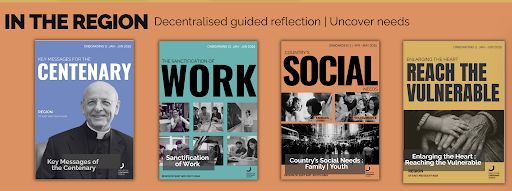
Four guided reflection materials* helped local teams explore key themes in their countries
They also revisited the contributions made during the 2024 regional assemblies, especially the question about the legacy, ie. what do we hope the centenary will leave behind for the next hundred years? The responses pointed repeatedly to a deeper interior life, the sanctification of ordinary life, friendship and community, clearer communication about Opus Dei, care for people in need, the formation of young people, and fidelity joined to renewal.
The value of this process has been its local focus. Conversations about work, for example, have surfaced issues such as the dignity of manual and less visible forms of labour; the pressure to measure work by income, status or performance; the search for meaning amid stress; and the need to integrate work, family, faith and rest. Reflections on families and young people have brought up psychological distress, intergenerational tensions, demographic pressures and social isolation. The challenges are not identical in every country, hence local listening matters.
Spreading the message and making needs visible
The present phase is one of transmission and discernment. No set of regional initiatives has yet been identified. The local teams are sharing the centenary’s key messages, communicating what they have learned about their countries and helping others see where a response may be needed. The hope is that this wider awareness will spur ideas and action from people closest to those realities.
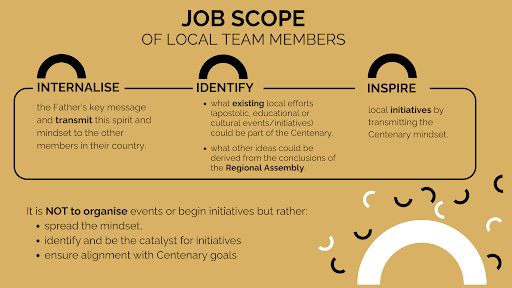
Local teams internalise, identify and inspire
The material gathered so far suggests many possible directions. In communication and formation, examples discussed include translations, podcasts and audio reflections, public talks, parish presentations, articles, media conversations and seminars on Catholic social teaching. Reflection on work has raised possibilities such as professional round tables, research on the meaning of work and pro bono service in fields such as law and education.
For families, young people and people in vulnerable situations, conversations have mentioned educational support, residential accompaniment, peer-support programmes, forums for hope and dialogue, mental-health awareness, family support groups and practical studies of local needs. At a wider regional level, ideas such as a book or exhibition on the history of Opus Dei in Asia, or a multi-city gathering, have also been raised.
These are not confirmed projects or an approved regional programme. They are examples intended to help people imagine what could grow in their own circumstances. Some may develop; others may change or give way to better responses. The priority now is to understand the needs, spread the centenary mindset and invite personal and collective initiative.
The teams have also reviewed suggestions and resources shared from the central committee in Rome: material on the charism and history of Opus Dei; formation in the Church’s social doctrine; projects centred on work; possible histories, biographies, documentaries and exhibitions; ways to reconnect with people who were once close to the Work; and a social legacy attentive to emerging needs. Here too, the question is not how much can be organised, but what can genuinely serve people in the different contexts of East and South Asia.
Five principles for initiatives and projects
As ideas begin to surface, the regional committee is using five principles to guide discernment. Any initiative should be service-oriented rather than self-focused; participatory rather than centralised; reflective rather than superficial; open rather than inward-looking; and sustainable rather than fleeting.
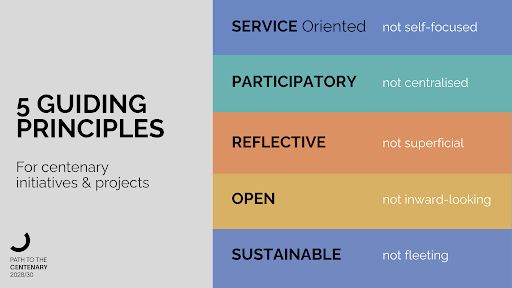
Five principles guide the discernment of any future initiative.
The real test will not be the size or visibility of a project, but whether it helps people renew their interior life and apostolic zeal, responds to a genuine local need and leaves something worthwhile behind. Existing personal and institutional efforts may be seen with fresh eyes and strengthened; new projects may emerge where they are genuinely needed and can last. The committee can help connect similar ideas and coordinate larger efforts, but the initiative itself should grow as close as possible to the people and places it hopes to serve.
What is happening now
Local teams are sharing the fruits of the reflection process, transmitting materials from the regional and international committees, gathering feedback and helping people recognise the needs around them. The core team provides a regular exchange between countries so that useful insights can travel across the region without forcing every country into the same plan.
Everyone can begin now: by praying for the fruits of the centenary, renewing the way they live their work and relationships, paying closer attention to a need around them, or sharing an idea that may deserve further reflection. The first step is not necessarily to launch something new. It may be to understand the centenary more deeply and help someone else discover how the spirit of Opus Dei can serve the Church and society today.
In a region as diverse as East and South Asia, unity will not mean doing exactly the same thing everywhere. It will mean sharing the same desire to listen, to serve and to prepare for the next hundred years with hope. The committee is helping to spread that message and prepare the ground. The hope is that the next initiatives will come from people who hear it and make it their own. Regional vicar, Fr Ralph Valdes, added, “The Centenary is the perfect opportunity for all of us to review and renew our dedication and learn from across the region, to discover opportunities to serve Church and society.”
*Links to the reflection material can be found here :
Country’s Social Needs - Family and Young People
Enlarging the Heart - Reach the Vulnerable