

When Karen Joy Daguiog walked through the gates of Poblacion Elementary School in Muntinlupa City (southern Metro Manila) early this year, she was not just showing up for work. She was walking back into her childhood.
Years ago, Karen sat in these same classrooms. She was a young girl with big dreams, but she also knew the quiet anxiety that hovers over homes where money is tight. Returning recently as a newly appointed staff member, she looked at the young faces greeting her and recognized a familiar vulnerability.
Many of these children belonged to poor families relocated from informal settlements along the local railroad tracks. For them, learning was constantly interrupted by the sharp, distracting pangs of an empty stomach.
According to the March 24-31, 2026 Social Weather Stations (SWS) survey, as many as 23.2 percent of Filipino families—nearly one in four households—suffer from involuntary hunger. This means that at least once in the previous three months, they had nothing to eat.
Confronted by this reality, Karen refused to look away and sought local hands-on action.
Building Bridges of Kindness
She found her answers in a core principle of Catholic Social Doctrine: “subsidiarity.” This idea states that societal wounds are best healed at the most immediate, local level.
She approached Father William Ramos, the parish priest of the nearby Quasi-Parish of San Pedro Calungsod. Together, they built a bridge between the church and the school principal, Dr. Jennifer Joson. Karen proposed a direct feeding intervention. Her plan led to her appointment as Program Director for "Balik Lusog"—a community-driven initiative designed to feed 500 of the school’s most undernourished children from Grades 3 to 6 every day.
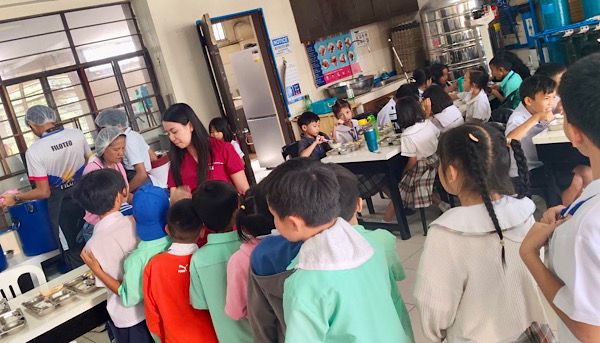
But how does a single public school find the resources to serve 500 hot, nutritious meals daily? The answer lay in the logistics network of the Philippine Food Bank Foundation, Inc. (FoodBank PH).
The Philippine Food Bank Foundation
Founded in 2016 and incorporated in 2017, the NGO was born in response to Pope Francis’s global call to reject the "culture of waste." The Pope lamented the terrible paradox of modern societies throwing away millions of tons of perfectly good food while millions of families starve.
Heeding this call, some members of Opus Dei and their colleagues—Dr. Lito Sandejas, Dr. Bernie Villegas, Jimmy Ladao, Danny Navarro, and Itong Torres, later joined by Quintin Pastrana, Chito Perez, and Mike Torres—set out to build a food rescue system. FoodBank PH founder, Dr. Lito Sandejas, lent his warehouse in Laguna and provided the initial funding.
The foundation's journey began with a single breakthrough. Dr. Bernie Villegas, serving as a director for Alaska Milk Corporation, convinced the company to donate near-expiry canned milk to poor communities in Muntinlupa and technical schools in Laguna.
"Charity is not something we ourselves build up. It invades us along with God's grace, 'because he has loved us first.' We would do well to fill, to saturate ourselves with this most beautiful truth..."
— St. Josemaria Escriva, Friends of God, 229
From Throw-away Surplus to the Plate
The genius of FoodBank PH is its ability to solve surplus food logistics and distribution issues. In its early years, the foundation struggled to collect perishable food from over 200 Starbucks branches across Metro Manila because of traffic.
To solve this, Starbucks partnered with Grab. Motorbike delivery riders began picking up near-expiry pastries nightly, bringing them to the foundation’s warehouse in Laguna at zero cost. Today, this network coordinates the distribution of over 12,000,000 pesos worth of surplus food every month across the country.
For the Balik Lusog program in Muntinlupa, this network mobilized an extraordinary alliance. Healthy proteins were donated by Century Pacific, Max’s Group, and the San Miguel Foundation. Carbohydrates came from Hikiniku, Tanging Yaman, and Good Eats, while fresh vegetables were supplied by Sari-Suki. This surplus food was sent straight to the Loaves & Fishes Community Kitchen in Filinvest.
Under the guidance of nutritionists from De La Salle University-Medical Center, these raw ingredients were transformed into clean, balanced meals. Cooked rice was carefully re-engineered into warm, fortified porridge to ensure safety and quality.

The final step relied entirely on human kindness. Every school day, parents of students from PAREF Southridge, a nearby school, volunteered their cars and time to drive the hot meals directly from the kitchen to the public school.
The Miracle of Solidarity
The daily distribution inside the Poblacion Elementary School became a moving testament to community spirit. A synchronized team of five school staff, five neighborhood parents, thirteen Southridge volunteers, and eighteen local parishioners served the children. Over a rigorous 38-day cycle from January 26 to March 19, 2026, these volunteers built a sanctuary of reliable care.

The outcomes compiled at the end of March 2026 were miraculous. A definitive 95 percent of the participating children recorded a healthy increase in their body weight and Body Mass Index (BMI).
Even more profoundly, the program shattered the myth that poor children lack intellectual potential. By comparing test scores, school administrators documented a massive leap in academic performance. Proper nutrition manifested instantly in sharper focus, better classroom participation, and a readiness to learn.
Foodbank PH will be refining the Balik Lusog model so that it can be replicated in all the public schools of Muntinlupa. The vision is to have the program adopted by analogous collaborative efforts among the Department of Education, parishes, private schools, private foundations or NGOs involved in food banking, local government units, and business establishments (especially in the food business).

By routing corporate abundance through local neighborhoods, FoodBank PH proves that charity is not just an occasional handout. It is a warm, daily grace that feeds both body and soul, showing a vulnerable nation how to heal itself from the ground up.
Opus Dei is an institution of the Catholic Church that helps people in all sectors of society find God in ordinary work and daily life, while serving the needs of the Church and the common good.