
In the days leading up to the Easter Triduum in Rome, Msgr. Ocáriz met young people from around the world to talk about faith, work, friendship, and much more.
On the afternoon of Monday 30 March, hundreds of female university students welcomed Msgr. Fernando Ocáriz to the sound of the official anthem of the Milan 2026 Olympic Games, performed on violin. UNIV’s 2026 theme is “Building Bridges: the Art of Dialogue,” and it brought students from every part of the world to Rome for a time of reflection and conversation on the challenges facing contemporary society. The Prelate opened the gathering by lighting a candle before an image of Our Lady Queen of Peace, offering prayers in a particular way for countries affected by conflict.
Msgr. Ocáriz encouraged those present to live these days with deep gratitude, keeping their hearts fixed on the mysteries of Holy Week: the Eucharist, the Passion, and the Resurrection of Christ. He also urged them to hold on to a positive and optimistic outlook, despite difficulties in our personal lives and the troubles in the wider world: “We always have something absolutely fundamental, and that is God's love for us.” He recalled Saint John’s words: “We have known and believed the love that God has for us” (1 Jn 4:16).
The Prelate reflected in particular on how Christians “must believe in God’s love for us in order to live a joyful Christian life. We are not relying solely on our own strength; we have God's love for us, for each and every one of us.” He also spoke about the need to have “a universal soul. The whole world belongs to us. So when we hear good news from anywhere in the world, it is ours to rejoice in. And when we see so much suffering, so many wars, that touches us deeply too. Everything is ours. This is not meant to overwhelm us. Because everything is ours, all the strength, all the goodness, all the prayer in the world also reaches us. We are never alone.”
Noting that the Centenary of the Work is now very close, the Prelate remarked that a central idea is that “the Centenary is not about commemorating the past, but about being conscious of a present reality.” For this reason, he added, the Centenary is also a point of departure in which every person has a part to play.
At his meeting with male university students on Wednesday, Msgr. Ocáriz encouraged them to step up their prayers for the Pope, particularly given the current climate. He invited them to make a concrete resolution for Holy Week of praying a little more each day for the Holy Father. He also spoke at length about the value of freedom: “May we all feel truly free, for the great freedom of loving.” He observed that true freedom does not consist merely in making choices, but in willing the good and loving what is truly worthy of love. “In Heaven,” he explained, “freedom endures in its fullest form, which is love.”
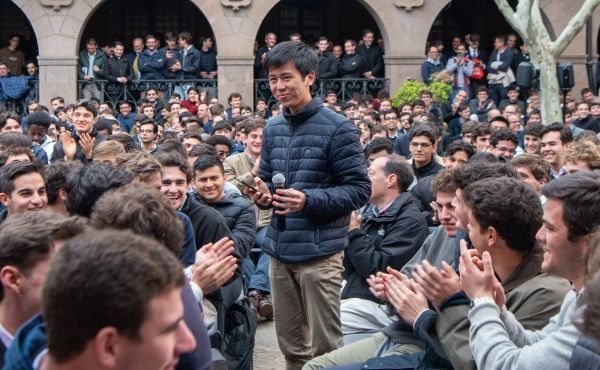
Real friendship across difference
Amira, from Nigeria, told the Prelate that she is Muslim and had come to UNIV at the invitation of a Catholic friend. She asked how dialogue can help us move beyond assumptions to genuine understanding, and how we can build authentic friendships with people of different beliefs. The Prelate spoke about what true friendship really means: not mere acquaintance, but “a form of love, willing the good of the other person, and that is always possible with anyone, whatever they may think,” provided that person is open to loving and to being loved. “That is why,” he concluded, “when there is true friendship, what one carries within tends to be shared naturally. That is the very heart of friendship: giving what one holds inside, not to impose anything, but out of genuine love.”
Other contributions highlighted how central friendship is to Christian life. A young man from Moscow, from an Orthodox family, shared his journey of drawing closer to the faith. When he spoke about the difficulties he faced and a lack of understanding from those around him, the Prelate emphasised that faith is transmitted above all through personal encounter and authentic friendship: what we give others is what we carry in our hearts and souls. This necessarily goes together with prayer for each person, trusting that it is God who transforms souls.
In the same vein, he responded to another student’s concern about how to accompany friends whose way of life is far from the faith. He stressed the importance of common sense and sincere friendship; the kind that knows how to love without endorsing what is not good. He invited them to embrace patience — “by your endurance you will gain your souls” (Lk 21:19) — as the key to walking alongside others on their personal journeys.
He also noted that a spirit of service is one of the most natural ways to draw people closer to Jesus: living in such a way that others notice and find themselves asking where it comes from, and so coming to discover Christ, who is “among us as one who serves.”
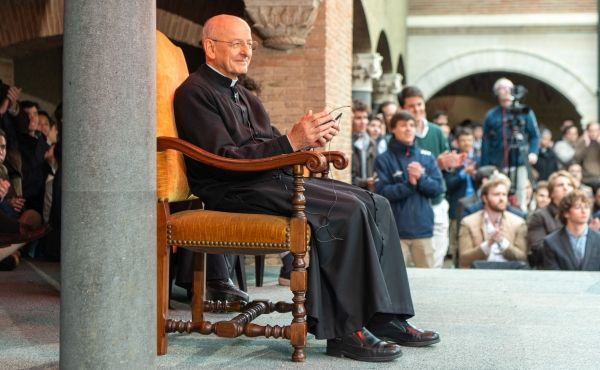
The value of work
Clara, from Madrid, recently discovered the work of the Administration, is made her wonder how to approach her work with a deeper sense of purpose, beyond money or status. The Prelate replied that the key lies in the desire to serve and to make life better for others. “What is often missing is the understanding that work is not only for the benefit of the person doing it. At its heart, work is a service. We need to foster and communicate not only the necessity of work, but also its beauty and its greatness as an act of service.” Msgr. Ocáriz encouraged those present to “discover and appreciate this dimension of service in work,” since it “helps us to work better and with greater joy, and is also the foundation for that work to be raised to the supernatural order in Christian life.”
Ignacia, from Chile, asked how we can make good use of artificial intelligence without losing the effort and the human virtues that make our work a genuine offering to God. The Prelate encouraged her to use it where it is appropriate and helpful, but then to “take what we have learned and truly make it our own: not simply absorbing knowledge passively, but taking that knowledge — made so much more accessible through artificial intelligence — and using it to develop our own thinking.”

This year, close to 2,500 students from more than 26 countries are in Rome to participate in UNIV 2026, an international meeting of university students who wish to experience Holy Week with the Pope. In addition to the liturgical celebrations, participants will be able to attend several encounters with the Prelate of Opus Dei, Msgr Fernando Ocáriz, and two academic forums (UNIV Forum and UNIV Lab) which will take place on Tuesday and Wednesday at the Pontifical University of the Holy Cross, to explore and debate the theme, "Building bridges: the art of dialogue."
The challenge of truly listening to one another
This year's reflection begins with a paradox that many will recognise. Pedro Lima (Brazil), one of the organisers, puts it this way: "We live in an era of hyperconnection and, paradoxically, of loneliness: we've never had so many voices around us and yet so little ability to truly listen to one another. That's why our generation's most urgent challenge is learning to dialogue, listening and being open to change, seeking the truth together, and seeing others not as adversaries but as fellow travellers on the journey."
Pili Fernández (Guatemala), another one of the organisers, adds: "UNIV is a time to pause and reflect on how we want to continue building the world and our relationships with others. There will be a lot of discussion about dialogue and truth. Truth is the driving force of a healthy curiosity that allows us to adjust our gaze to reality and open ourselves, with wonder, to dialogue with others."
Speakers, masterclasses and culture in Rome
The programme includes conferences, artistic exhibitions and masterclasses with speakers from very different backgrounds: Hope Kean, cognitive neuroscientist at MIT (USA); Santiago Martínez, director of Inter-Cultur; Jack Valero, co-founder of Catholic Voices; Caitlin West, creator of the Crash Course Catholicism podcast; and Juana Acosta, professor at the University of La Sabana (Colombia) and expert in strategic litigation for the defence of human rights, amongst others.
Youth: the encounter continues beyond Rome
Being in Rome means immersing oneself the heart of the Church and the cultural, spiritual and artistic heritage of the city. But the encounter doesn't end when you go back home. Youth is a digital space on opusdei.org by young people and for young people, and it supports the journey back with text resources, audiovisual material for prayer, and content for a deeper understanding of the faith and tools to grow as a personal. It is meant to help young people be builders of dialogue and peace, as Pope Leo XIV encourages them to be.
With our sights set on peace
The UNIV gatherings began in 1968 under the inspiration of Saint Josemaría, founder of Opus Dei, as an experience of the universality of the Church and union with the Pope. Over the past 58 years, more than 100,000 university students have taken part. As a token of gratitude, participants customarily visit his remains in the prelatic church, Our Lady of Peace.
This edition also has a charitable dimension marked by the Holy Father's call for peace and the situation of so many countries immersed in conflicts, persecution or natural disasters. UNIV 2026 participants will promote initiatives connected to the Be Do Care project, which supports social, professional, and ecological projects throughout the world.
More information at univforum.org and univinspire.org.