

Photo gallery
Wednesday, 12 August: “I have learnt a great deal from you” in Tegucigalpa
In the morning, students, employees, teachers and alumni of the Instituto Tecnológico Taular welcomed the Prelate of Opus Dei, with whom they shared their work, as well as their joys, difficulties and personal stories, and to whom they expressed their gratitude for everything that has been done there over the past 30 years.
Germán came to Taular as a young man from Guayabillas, a small rural community some 42 kilometres from Tegucigalpa, with the dream of making something of himself. On Wednesday, many years later, he returned to the same place and told the Father what that opportunity had meant in his life.
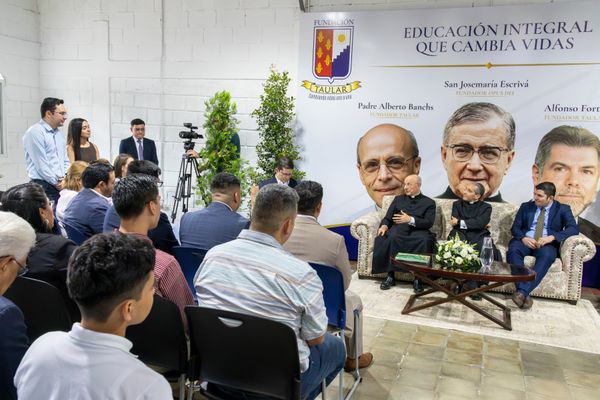
Germán shared his story with the Father
Today he is an industrial engineer, holds a master’s degree from a university in Barcelona, works in the management of one of Honduras’ leading commercial retail stores, and married his wife Valeria a year ago. Yet in telling his story, Germán did not begin with his qualifications or his job. He spoke of the people he met at Taular and of a formation that, as he explained, helped him to grow both humanly and spiritually.
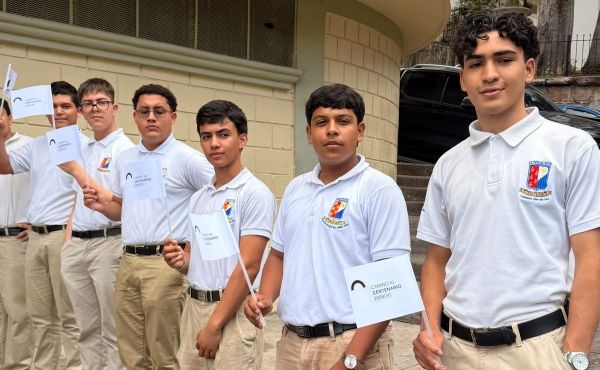
Next to speak was Christopher, a young student who lives in an area of the city marked by insecurity. He recounted how he is often unable to leave his home freely, play, or make friends near where he lives. For him, Taular represents a place where he feels safe, where he has found friends and people he can trust, and where he receives the encouragement to study, to improve himself, and to become a better person.
There were also family stories. Azael, the father of one of the pupils, shared that for a long time he had considered himself a “man of science” with little space for faith. The death of his father and the illness of his youngest son led him to experience the grace of God and the closeness of the Virgin Mary, he said.
Since 1997, Taular has worked to provide young Hondurans with academic, technical, human and spiritual formation. Stories such as those shared alongside the Father show the people behind the classrooms: families, support from friends, and staff working to help others discover their potential and look towards the future with hope.
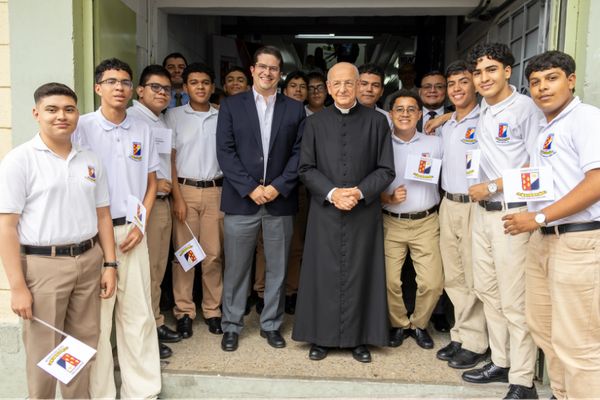
At the close of the get-together, the Father thanked those who had shared their stories with him: “Thank you very much; I have learnt a great deal from you.”
With families in Tegucigalpa
With the joy and affection that have come to be hallmarks of these gatherings, Hondurans of all ages came together in Tegucigalpa to be with the Father. The atmosphere had the feel of a family reunion and the simplicity of welcoming a much-loved guest into one’s home.
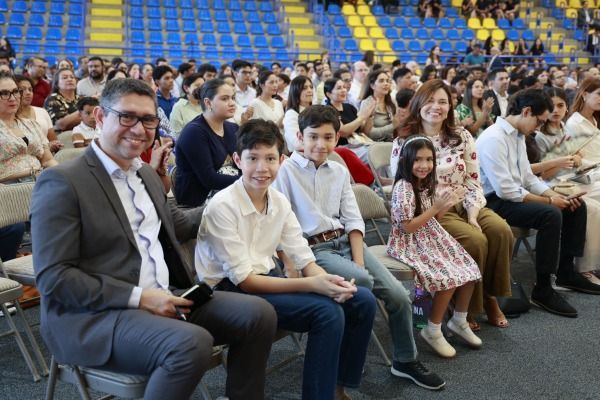
At the start, the Father recalled the special place that Honduras holds in the history of Opus Dei: it was the Honduran legation in Madrid that, for five and a half months during the Spanish Civil War, sheltered St. Josemaría and some of the first members of the Work. Drawing on this memory, he underlined that even in moments of suffering and uncertainty, God is always present, “just as He is, with love,” even though we often fail to see it.
The conversation continued with Sofi, a medical student, who said how there were moments in her life when her mind was overwhelmed and her heart racing, and that as a result her prayer risked becoming a monologue of worries and anxieties rather than a genuine encounter with the Lord. In response, the Father explained that those very concerns, far from distancing us from God, can become the subject of prayer and an occasion for dialogue with Him. To achieve this, he noted, it is important to begin from divine filiation, feeling oneself a deeply beloved son or daughter of God.

Tony, the first supernumerary of Opus Dei in Honduras, then took the floor to raise a concern: how to help younger generations live their vocation with the same urgency, fervour and daring that characterised St. Josemaría. The Father clarified that the need for generosity belongs not only to the young, but to everyone, always. The key lies, first and foremost, in prayer and in conveying that spirit with an optimistic outlook and the example of a life given in service. He emphasised that it is not a matter of age, but of the maturity born of experience. “We never retire here,” he recalled, affectionately quoting St. Josemaría.
The afternoon also included a moment of early celebration, since 15 August marks another anniversary of the Father’s priestly ordination. On this occasion, Gracia and Mauricio gave him a cigarette case and by a cover in the colours of the Honduran flag. The gift was not meant to be practical, since the Father does not smoke, but was rather a reference to a Eucharistic memory: during the Civil War, risking his life, St. Josemaría used a similar cigarette case to carry and protect the Blessed Sacrament through the streets of Madrid, in order to bring Holy Communion to family and friends.
Throughout the gathering, a group of young people also enlivened the atmosphere with musical performances that highlighted Honduran culture.
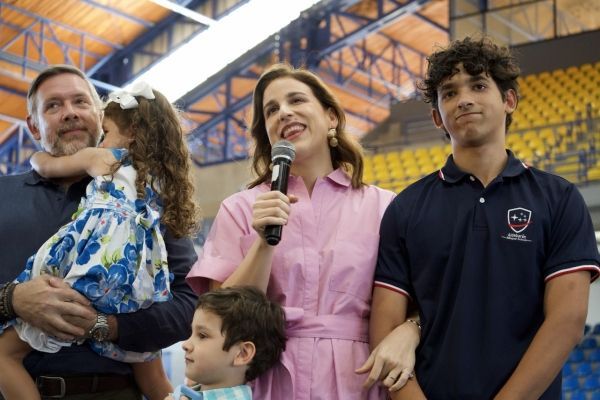
Later, Teté, a mother, shared part of her life story. Sixteen years ago, her son Toñito was born with a rare congenital condition that, at the time, was considered incompatible with life. In March 2025, doctors warned them that there was little more that could be done, because the treatment on which he depended was no longer working. That same year, a new medication came onto the market — the first in fifty years — which could change the course of Toñito’s condition, but its price was beyond what the family’s could afford. Together with a group of friends and her family, she began a novena of the sick to St. Josemaría. On the ninth day of prayer, they received a phone call from the pharmaceutical company: they would provide her son with the treatment free of charge for the rest of his life. At the end of her account, the Father joined in her thanksgiving for this gift and for St. Josemaría’s intercession.
The gathering concluded with the Father’s blessing, as he thanked everyone for their warmth and asked for prayers for the Pope and all the people and intentions that occupy his work and his heart.
Tuesday, 11 August: Get-together at Ilama
On the morning of Tuesday 11 August, the Father visited the Basilica of Our Lady of Suyapa in Tegucigalpa, accompanied by some members of the Work, to place the intentions of everyone he has met over the course of these days in Central America in our Lady’s hands.
Straight afterwards, music opened the first gathering of the day, in which laughter, gestures of affection, and questions followed one after another at Ilama Centre, where the Father met with a group of young Honduran women.
The gathering was an occasion to recall the months when St. Josemaría took refuge at the Honduran Legation in Madrid during the Spanish Civil War. The very country that had sheltered him and some of the first members of the Work in that small space was now welcoming the Father across its entire territory and in a festive atmosphere.
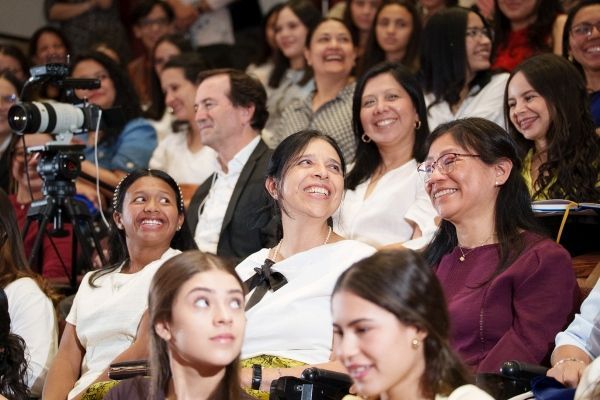
Some time ago, Sonia began giving catechism classes every Saturday together with some friends. She acknowledged, however, that at times her good intentions were mixed with a desire to look good, to be recognised, or simply to feel satisfied with herself. She asked the Father how to guard one’s heart and give it direction.
Acting out of love for God corrects our intentions, the Father told her: “We have a tendency to want to look good, and so we must rectify our intention. We should not be surprised or disheartened when we experience that tendency.” Instead, he encouraged them to ask God simply: “Help me to have a better intention, so that everything may be for your glory.”
Marcela asked how to distinguish true Christian love from the ideas that predominate in today’s culture, in a society where the word “love” is used to describe almost any kind of relationship or feeling. The Father's response was straightforward: “Authentic love seeks the good of the people one loves. That is real love, not self-satisfaction. That is what causes love to become ever more purified.”
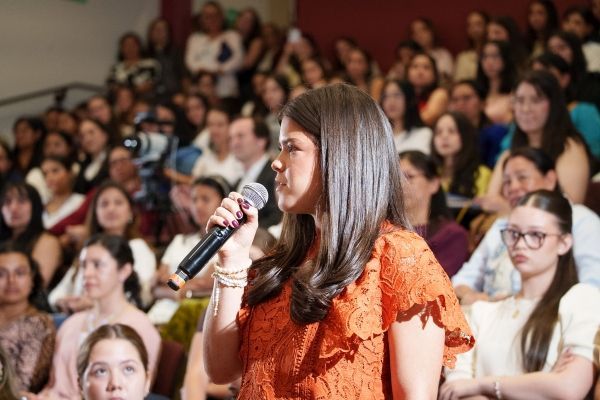
Andrea then raised a personal concern: how to overcome the fear of God’s bold requests — such as a vocation — and to remain faithful to so great a commitment. The Father encouraged her, above all, not to rush, recalling the motto on the Escrivá de Balaguer family coat of arms: Alma calma (“Energetically, but calmly”). “First, one must think calmly, seeking counsel and light in prayer. And then ask for help from someone who can accompany us with prudence.”
Amid this joyful atmosphere, a group of young people sang a song. On hearing it, the Father remarked: “This leads me to think about dying of love. The Cross of Jesus Christ is the proof of love. He died of love. And as Benedict XVI used to say, the Cross is the greatest act of human freedom through love.”
Bianca shared a very specific concern: how to forgive and love a neighbour when we have been hurt, especially when, despite trying to forgive, feelings of anger or sadness remain in us.
The Father then recalled some words of St. Josemaría: “The most divine thing about love for God is to forgive those who have hurt us.” And another of his expressions: “I have not needed to learn to forgive because God has taught me to love.” The key, he told them, lies in asking the Lord to teach us to love, “and then it will be much easier to forgive.”
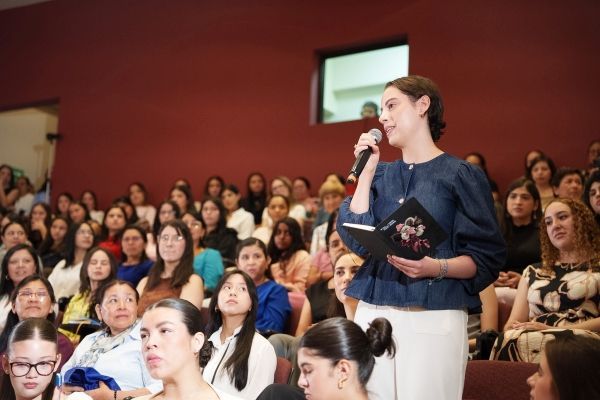
Karina, who has been working in the administration at Espave for a year and a half, shared how she has grown closer to God through that work, learning to value the care of each person and getting to know Opus Dei better. “A helpful, teaching atmosphere can be created through very material things,” the Father said. “That is why this work is so important.”
Paulina, who is in her second year of biology, shared that she often encounters people with different beliefs. The Father encouraged her not to fear being in the minority in a university environment. He reminded her that, from its very beginnings, Christianity has pressed forward despite difficulties: “The Apostles were the first martyrs; yet the Church continues going forward.”
The conversation then turned to a very topical subject: artificial intelligence. Gaby asked the Father to speak about how, from the perspective of faith and Christianity, we can avoid losing empathy and continue to connect genuinely with our neighbour. “Not losing empathy means loving people.” At the same time, he noted that technical advances can and should be used for good: “We must make use of the reality before us, and these technical processes, for good, educating ourselves in their use and in the proper use of all these means.”
Katherine comes from Terra Sur, a coffee-growing area of Costa Rica, and gave the Father a sample of that coffee on behalf of her family. She currently studies at Surí Centre and works in the administration of the Pedregales retreat house. From that experience, she wanted to know how to live a love for the small details and offer God first-quality coffee in her daily life.
The Father took the opportunity to tell them that “life is full of small things: caring for relationships with others, greeting people, smiling, keeping your room tidy. Great things are accomplished in the small things and in ordinary life.”
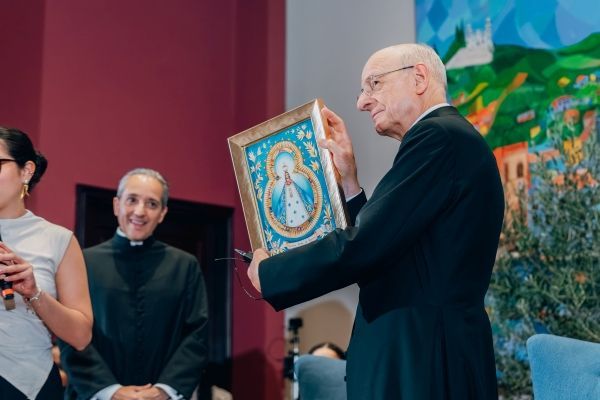
At the end, the Father asked them to pray for the Pope and invited them always to be joyful.
“Put out into the deep,” an invitation to young Hondurans
On the afternoon of that same day, the Father met with another group of young people. Moisés, Ángel, and Jorge opened the gathering by singing “En mi país” (“In my country”). The Father remarked that good music gives us strength and can become a song to God when its lyrics are helpful.
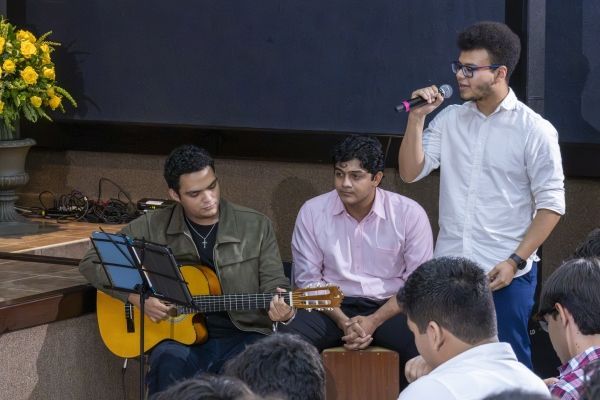
Franzuá, a physics student, wanted to know how to draw his university classmates closer to God. The Father advised him to cultivate true friendship, learning from others, accompanying those relationships with prayer, and sharing naturally what he believes: “It is about creating an atmosphere of sincere communication.”
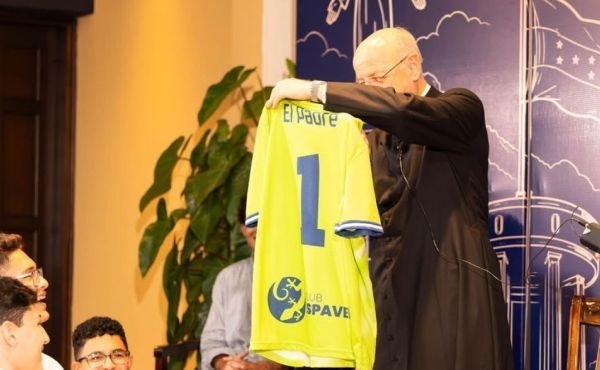
Pablo and Nelson gave the Father a football shirt after telling him about some of their sporting achievements. They asked how sport can contribute to Christian life. Msgr. Ocáriz highlighted the value of discipline, effort, and perseverance. Just as an athlete has a training plan and strives to follow it even when motivation is lacking, in the spiritual life it is good to have a plan of life and to make the effort to live it.
“We cannot do things only when we feel like it,” he explained. Prayer, Mass, and the other Christian devotional practices have a supernatural value, but they also help to form people capable of meeting their duties and pressing forward.
César, aged 17, raised a question about unity of life. Between school, family, friends, sport, and formation activities, he admitted that he sometimes feels that his energy was not enough for everything. The Father explained that all aspects of life, however varied, can find in love the source of their unity.
“We can love in everything,” he said. When God enters our life, he explained, we can truly be the same person whether we are studying, working, resting, or facing a difficulty. “What can unite all those realities is the love of God,” but unity of life is not achieved all at once: “We need to strive every day. And when we fail, begin again.”
Recalling Christ’s call to St Peter (“put out into the deep”), Sergio shared a concern: how not to remain on the shore, how to avoid settling into comfort and to keep our response to God alive. The Father invited him to venture into deep waters through the Gospel, an essential source for knowing and having a personal relationship with Jesus Christ. He suggested that this going deeper can begin with a very simple prayer: “Lord, I may not know what to say to You, but I want to be here with You.”
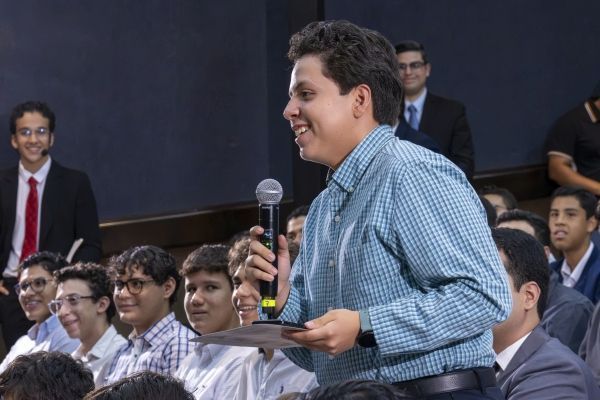
Johan, a computer science student, wanted to know how to turn study into prayer. The Father responded from his own experience as a university student in physical sciences, noting that study and the sciences can lead one to marvel at creation. He recalled that many of the great scientists have been believers, and that this is possible when science is approached with wonder rather than in a purely pragmatic way. He suggested a way to begin our work with a small movement of the soul: “Lord, I offer You this work. Help me to do it well and also to help others through it.”
David, who wishes to serve others through dentistry, asked the Father how to maintain the presence of God throughout the day. “We all need his strength and his grace,” the Father replied. “It is not enough simply to resolve to do so: concrete means are needed, such as Mass, prayer, and the Gospel.” In this way, those moments “give us strength so that, little by little, all of life may be oriented towards Him.”
Santiago asked about freedom, which can sometimes be affected by sentimentality. The Father explained that being free does not simply consist in doing whatever one wants. “Freedom is, above all, the capacity to love.”
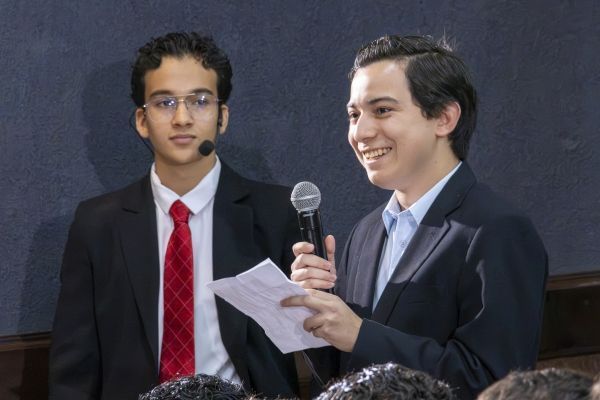
Finally, Juan Antonio asked the Father for a word for the young people of Honduras. The response was simple and direct: “Seeking Jesus Christ is worthwhile.” Not only in certain specific things, however important they may be, but in a Person: Jesus Christ. The Father also encouraged them not to be afraid in an environment that may seem unchristian: “The Lord wants to count on you to help others and to bear witness.”
And in the face of difficulties, temptations, or even falls, he reminded them: “The important thing is to get up and keep striving without losing heart.”
The gathering ended with the Father’s blessing, a photograph, and an invitation help others discover the beauty of Christian life.
Monday 11 August, meeting with families in San Pedro Sula
The Father thanked them for the warmth with which he was welcomed to the city. He spoke to them affectionately, using St. Josemaría’s expression “martyrdom of the ordinary” to speak about holiness in everyday life: alongside the extraordinary deeds that God asks of some people, he asks the majority of us simply to live well, through work done with love, patience in the face of small setbacks, and daily care for our families.
“That ordinary life is not unimportant: it is of great value because of the love we put into it,” he said, adding that whoever thinks more of others than of himself ends up being not only more effective, but happier.

Daisy is a doctor and mother of three children; she and her husband are both members of Opus Dei. She shared how, not long ago, she experienced the loss of a baby before birth, whom they named Fátima. With that experience as a backdrop, she asked how to learn to have the same infinite patience she’s felt from God with others and with herself. The Father invited her to seek Christ in others, quoting a phrase of St. Josemaría: “Charity, more than in giving, consists in understanding.” “Every person is worth all the blood of Christ,” he told her, even when someone is disagreeable or thinks differently.
Marco and his wife Lori support initiatives for children from vulnerable areas of the city, and shared a concern that many people face sooner or later: how do you keep persevering when results are slow to come? The Father replied that, when faced with challenges, wanting something is not enough: you need to be in love. “Fall in love, and you will not leave Him!” he said, evoking the advice that St. Josemaría gave to people who feared they might not persevere in their task.

Juan Pablo, accompanied by his wife Camille, wanted to know how to help young people living in complex contexts — social media, artificial intelligence, social and political change — that make it difficult for them to find their purpose in life. The Father suggested they seek strength not in themselves but in God, in prayer, and in their work, which becomes prayer when it is offered to God with love. That, he said, is the key to the unity of life. Family, work and faith should not travel along separate paths, because God is always present in everything.
Victoria shared, with laughter and some nervousness, that she is getting married in five days. She asked the Father for advice on placing God at the centre of her home and the family life she is about to begin. The Prelate recommended trying to “seek the happiness of the other: you seeking his and he seeking yours.”
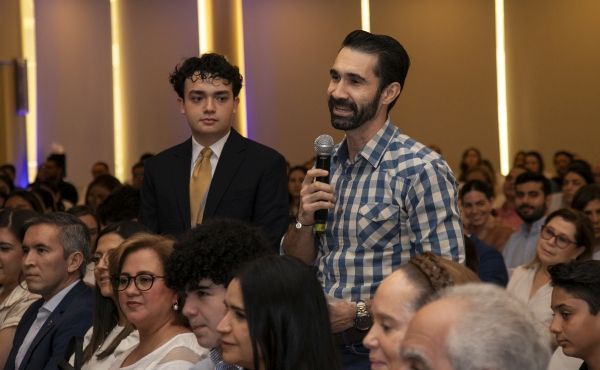
Rocío del Pilar spoke of a year marked by difficult decisions and moments of loneliness, and asked how to recognise God when He seems to be silent. The Prelate recalled the Gospel passage in which Jesus stays behind in the Temple and his parents search for Him anxiously for three days without finding Him: not even the Virgin Mary fully understood what was happening, and yet she kept all these things in her heart. We too can learn to trust without needing to understand everything, certain that God has never abandoned us, even when it may seem so.
A young woman, Shekinah, shared the story of her family’s conversion: it all began when she started attending the Jaribú club at the age of 13. Thanks to the formation she received there, a year ago she was able to receive Baptism, First Communion, and Confirmation. Through this experience, her parents and siblings also drew closer to the faith and were baptised. Her parents are now preparing to marry in Church on the coming 15 August.
Shekinah mentioned that she is learning to play the violin. She performed a piece that the Father greatly enjoyed, because it was the melody he had been listening to on the day he asked to be admitted to the Work.
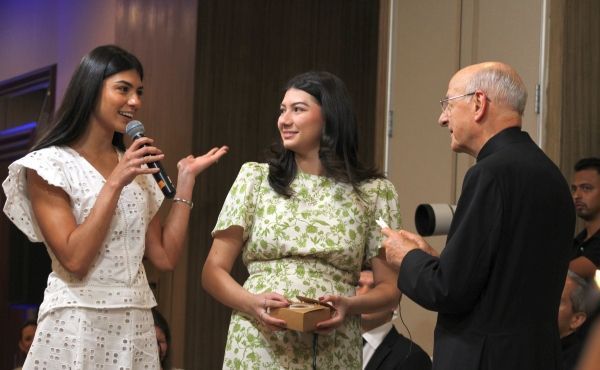
Dina brought the gathering to a close by sharing her story: she grew up in a village in Honduras, in a family of twelve siblings, with no electricity at home. On many nights she studied by candlelight. Despite these hardships, she went on to train as a teacher in several Central American countries and now lives in Panama.
“The place where we are born does not determine how far we can go,” she said, before asking how to keep the desire to keep learning and to serve others better alive. The Father told her that it is always possible to grow, even when a job reaches a material limit. The human quality with which it is carried out — the mind, the will, and ultimately the love one puts into it — can never stop growing.
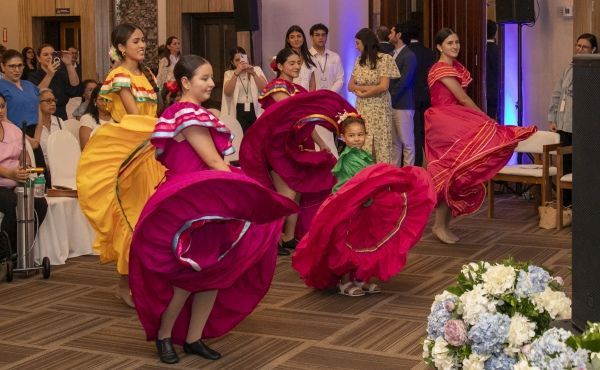
To close, some young women from the Jaribú club enlivened the gathering with a traditional Honduran dance of Garifuna origin, to the rhythm of the song Wéndeti Nagaira, which means “how beautiful is my land,” dressed in colourful traditional costumes.
On Tuesday, the Father will meet with two groups of young people in Tegucigalpa.