

In “The Wonder of America,” released Oct. 22, Archbishop José H. Gomez of Los Angeles asks Catholics to prepare for the 500th anniversary of the Guadalupe apparitions, in 2031, as a time of spiritual renewal and new missionary effort. He describes the apparitions to St. Juan Diego as “the true origin story for the United States and the nations of the Americas.”
The full text of the letter is available here.
Much of the letter is a reflection on the Nican Mopohua, the 16th-century Nahuatl account of the apparitions, and on what the Guadalupe story means for the Church’s mission in the Americas today. Among other things, the archbishop writes about how Our Lady has guided his own life, including a memory involving St. Josemaría.
When the young José Gomez moved to Mexico City for college, he began making frequent pilgrimages to her basilica. “A few months after I moved, in May 1970, the founder of Opus Dei, now St. Josemaría Escrivá, arrived there on pilgrimage to pray a novena. I was privileged to be part of the film crew in charge of documenting his time at Tepeyac,” he writes.
“Msgr. Escrivá was devoted to Mary, and there was an almost childlike simplicity about his devotion. When he was in his late teens and early 20s he had gone regularly to the Basilica of Our Lady of the Pillar in Zaragoza, Spain. There he would pray to know his vocation. He also had a small statue of the Virgin of the Pillar that he would pray before in his home. ‘My Lady, let it be!’ was how he prayed. ‘May whatever God wants me to do be done!’”

St. Josemaría came to Mexico, the archbishop notes, at a time of turmoil in the world and in the Church, which was struggling to implement the teaching of the Second Vatican Council. He came to pray for the pope, for the Church and for direction in his own life and ministry.
“For nine days he prayed in a little balcony where he could be closer to the divine image. Looking back now, I can see how Our Lady was at work. During those nine days, my love for her grew, and what God wanted for my life became clear. I knew with certainty that I wanted to give my life completely to Jesus,” Archbishop Gomez writes.
“At the end of those nine days, Msgr. Escrivá said: ‘In the end we didn’t pray for anything, we just said to her in all confidence, “Fiat! Let it be done!”’ I wanted to live that way, too. And I knew that by God’s grace, and with Our Lady’s help, I could do it.”
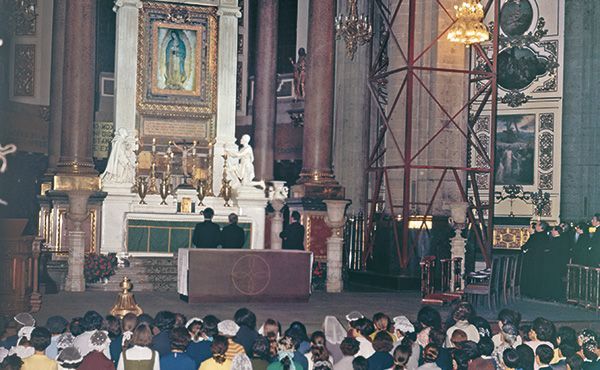
After his nine days of prayer before the tilma, St. Josemaría spoke of Mary as the mother of the new humanity, the race of the children of God. The archbishop quotes what the saint later told farmworkers in the Mexican state of Morelos:
“No one is greater than anyone else — no one! We are all equal! Each of us is worth the same, worth the blood of Christ. Just think how wonderful this is. For there are no races, there are no languages. There is only one race: the race of God’s children.
“Look at the beautiful, magnificent face that Holy Mary left in the hands of Juan Diego, on his cloak. You can see that her features are both Indian and Spanish. For there is only the race of God’s children.”
“The Wonder of America” is the archbishop’s third pastoral letter since he came to Los Angeles in 2010.
