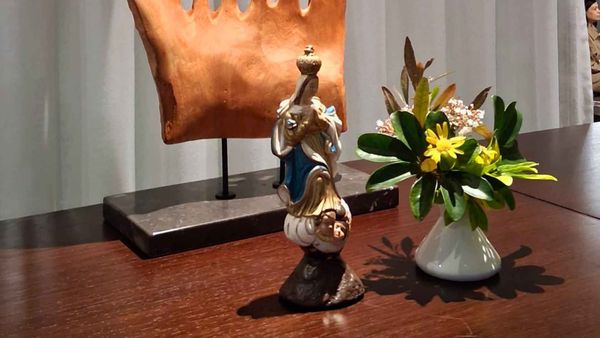
From Saturday 22 to Thursday 27 August, the Father made his first pastoral visit to Uruguay since being elected Prelate of Opus Dei, following his stops in Guatemala, Honduras and El Salvador.
The trip coincided with the lead-up to the 70th anniversary of the arrival of the first members of Opus Dei in Uruguay, which falls in October, on the path towards the centenary of the Work.
Thursday 27. The Father's last day in Uruguay
On his last day in Uruguay, Msgr. Fernando Ocáriz met with the organising groups behind various apostolic initiatives, who shared stories, projects and challenges from their work. The Father listened to them attentively and offered some words of advice. Before setting off on his return journey, he also met with several families.
So ended a few days marked by many encounters, from Casavalle to the University of Montevideo, by way of informal gatherings with young people and families.
At around 9:30 p.m., the Father's plane took off from Montevideo bound for Rome. A number of families came to see him off from the airport, accompanying him through the very last moments of his visit to the country. Amid embraces and farewells, a long-awaited journey came to a close, leaving behind the echo of many affectionate words and conversations throughout the trip.
Until we meet again, Father!
Wednesday, August 26. Class at the University of Montevideo and meeting with young people
During his visit to the university, he met with administrators, faculty, students, and members of the educational community, and gave a class on Christian identity in university life.
Before the session, the rector of the University of Montevideo, Alejandro Cid, welcomed the Prelate. He recalled the spiritual support and Christian guidance Opus Dei has provided to the University since its founding, and pointed out how relevant St. Josemaría's message still is today: seeking God in work and in everyday activities carried out in the service of others.
The Father began with the very heart of Christian identity: Jesus Christ. "What gives us our Christian identity is the presence of Jesus Christ," he said. He drew a distinction between two dimensions that must always go together: the Christian identity of an institution and that of its people. A university can have rules, principles, and structures that express its Christian inspiration, he explained, but these are not enough unless that identity truly comes alive in its people.
He touched on several aspects of university life: the harmony between faith and reason, respect for freedom, and the evangelizing role a university can play through science, the humanities, and university life as a whole.
He also spoke about the work of professors, who are called not only to pass on knowledge but to give of themselves to their students and to the colleagues they work with: "Christianity is also about giving oneself." From there he described authority as a form of service, and teamwork as "a great guarantee of effectiveness, because several pairs of eyes always see more than one."
He noted that a university depends on everyone, "from the rector down to its newest student," and that "the Christian spirit is passed on through science and the humanities, but above all through personal contact." Speaking about that personal contact, he dwelt on justice and charity, recalling a saying of St. Josemaría: "charity lies not so much in giving as in understanding." "The desire to understand," he added, "is the first step toward loving."

A conversation with those present followed. Sofía, from the School of Communication, asked how to carry into her career, family, and society what she had learned during her years at the University. The Father pointed to openness as a necessary attitude for listening to different opinions and points of view, and for carrying that balance between unity and diversity beyond university life.
Mónica, from the School of Psychology, shared the story of a student who began to wonder about faith after noticing that his Christian classmates were the happiest and most willing to help others. She wanted to know how the university's identity could be lived out freely by everyone. The Father said that friendship is the way to pass on the faith: "Genuine friendship is demanding, because it is a form of love," he explained.
Claudio, one of the university's earliest promoters, spoke of the joy of seeing it now in the hands of a new generation. Through the Fundación Amigos de la Universidad, he works to secure scholarships for young people who lack the necessary resources. "Every person matters, and anything that helps open up opportunities for others is deeply Christian," the Father said.
María José, who heads the Operations and Logistics area, asked about the value of the work done by those who keep the university running through non-academic roles. The Father noted that this kind of work is what allows everything else to function, and that the value of a task does not depend on its rank: recalling a teaching of St. Josemaría, he said that the most important work is the work done with the greatest love of God.
Martín, a doctor and surgeon, shared his dream of helping to launch a School of Medicine centered on the person, and asked how to approach projects that can feel too ambitious. "Sometimes you just have to take the leap," the Father answered. He encouraged combining realism with boldness, trusting in God's help to face whatever difficulties arise along the way.
There was also a question about the work university students carry out with people deprived of their freedom. The Father stressed the importance of helping them feel understood and loved. "What often hurts the most is loneliness — not physical loneliness, but loneliness of the soul," he explained.

Toward the end, questions turned to work, career plans, and the history of Opus Dei in Uruguay.
The University of Montevideo wanted to leave him with a few mementos of his visit. He received a notebook bearing the UM crest and an edition of Don Quixote produced by the university, which holds one of the most important Cervantes collections in Latin America. The edition commemorates the first complete publication of the work in South America, printed in Montevideo in 1880.
The meeting closed with thanks from the university community for the lessons, suggestions, and new horizons the Father had opened up that morning. "The University of Montevideo is your home," they told him as they said goodbye.
Wednesday, August 26. Meeting with young people
In the afternoon, the Father met with university students and young professionals who had come from various parts of Uruguay, along with some young women from Argentina, Paraguay, and Brazil. On stage, a line from St. Josemaría — "Your arms to Uruguay" — recalled words he had once addressed to a young Uruguayan in 1974, an invitation to once again put one's arms and heart at the service of the country.
At the start, the Father invited them to place Jesus Christ at the center of their formation and of their lives. He explained that being a Christian is not just about learning certain ideas or following certain practices, but about seeking and loving someone: "To know Jesus Christ, to walk with Jesus Christ, to love Jesus Christ."
He also spoke about not becoming discouraged by one's own limitations, and about being willing to start over again and again. "Holiness lies in the fullness of love, not in being free of flaws," he said, because even with our own limitations, it is always possible to begin again with greater love of God.
Pierina, an equine therapist, children's activity leader, and nurse, said she carries with her an image St. Josemaría used to use: ducklings jumping into the water even before they know how to swim. That image of "ducks into the water" helps her step outside her comfort zone, and it was what led her to ask the Father how to talk about God with friends and family. The Father emphasized friendship: when it is genuine, he explained, talking about what one carries inside comes naturally. He also noted that prayer is the first step toward being able to help others.

Abril, who lives at the Del Mar Residence, arrived this year from Treinta y Tres — a city 249 km northeast of the capital — to study accounting. She had never set foot in a church, was not baptized, and her parents are not believers. After arriving, she began meeting young people who lived out their faith naturally, and decided to start attending meditations. "I'm sure that coming to the Del Mar Residence was one of the best decisions I've ever made," she said.
Abril asked the Father to pray that her faith would keep growing. He recalled the request the apostles once made of Jesus: "Lord, increase our faith." Faith, he explained, is a great gift from God, but it also needs to be asked for and welcomed.

Pilar, 20, said that last year she lost two members of her family. The pain left her with doubts, and she struggled to understand how a God who loved her could allow something that caused her so much suffering. She asked the Father how to surrender herself into God's hands. The Father invited her to look to Jesus Christ on the cross, acknowledging that there are times when God's plans are hard to understand. "What we can do is love, even when we don't understand," he said. And he added: "God's love never leaves us, even when we often can't make sense of it."
Then came a moment straight out of the River Plate. Two young people performed a "payada" for him — an improvised sung verse accompanied by guitar — which made its way, with plenty of humor, through some of the traditions and friendly rivalries shared by the countries of the new Río de la Plata Region: mate, football, and even the usual back-and-forth with the neighbors. Before it began, two students from Los Pilares gave him a poncho as a gift. The payada ended by celebrating a region that, whatever its differences, shares one and the same heart.
Julie

ta, 18, said she went through a very difficult time in her teenage years, and that years later she clearly felt God's presence again at PREU — a pre-university institute in Montevideo — where she felt accompanied and loved. Later on, she started taking part in activities at an Opus Dei center. Now she wonders whether God might be calling her to that vocation, and wanted to know how to discern a decision that could shape her whole life.
The Father explained that God does not usually make the way forward so clear that all doubt disappears, because he deeply respects our freedom. He spoke about praying, seeking advice, and also being ready to make a generous personal decision. God leaves "a certain amount of darkness," he explained, so that each person can make "a generous gesture of throwing themselves into the adventure."
Maite, a Communication student and watercolor enthusiast, spoke about social media. On Instagram she shares her paintings and also tries to show her relationship with God in a natural way. The Father encouraged her to use that space to share the Christian life and build genuine connections, while noting that friendships formed online, however real, are not quite the same as the ones we build in everyday relationships.

Lula, who had designed the stage set, said she had discovered Opus Dei through a friend and has been a Supernumerary for just over a year. Faith has never had much of a place in her family, and some of her decisions have been questioned. She asked how she could share the joy of her vocation with her parents. The Father suggested a very concrete path: "Love your parents more, and love them better," because a deeper relationship with Jesus Christ has to lead, too, to loving one's own family more.
Mercedes, a hockey player from Los Ceibos, asked how to make sport into something more than just competing and chasing results — something that also helps her grow and bring others closer to God. The Father again pointed to friendship as the way to share the faith, and urged them not to feel intimidated in settings where God can seem far away, encouraging them to think instead: "Lord, count on me even more to help these people."

With the centenary of Opus Dei approaching, Mélani wanted to know what young people today can learn from those who lived through the early years of the Work in Uruguay. The Father encouraged all of them to remain faithful and to persevere on the path to holiness, without looking back on the past as some kind of "golden age," since those who came before them built up Opus Dei through an ordinary life — "through everyday work, and through starting over, again and again, each day."
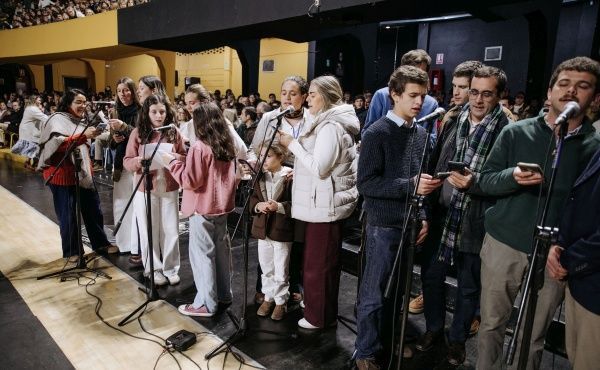
Before the Father gave his blessing, a group of young people sang "Oración del remanso."
Tuesday 25. Meeting with families
On the stage, a large mural inspired by the work of artist Joaquín Torres García brought together scenes representing each department of the country: a round of mate, work in the countryside and in the office, the home, sport, education, and health. A composition that also sought to represent St. Josemaría's message of finding God in the midst of everyday activities.
At 4:30 p.m., the wait was over. The Father was welcomed with great emotion. Marianne and Juan Pablo, who were in charge of leading the meeting, greeted him: "What a joy to have you in our country!"
At the start, the Father recalled that in a few months Pope Leo XIV will be in Uruguay, and he encouraged them to begin preparing for his visit now by praying especially for him, for his work, and for his intentions, believing with "great faith in prayer," he told them. Sometimes we ask God for something and what we hope for does not happen. But that, he explained, does not mean that God has forgotten us or has not listened to us. "Prayer is never useless. God always listens to us."
The Father also spoke of the difficulties and suffering that come, in one way or another, into life, and invited them to look to Christ on the cross and to trust in God's love even when we cannot understand what is happening. "If there is love, we can be happy despite suffering, because it is love that gives meaning to life," he said. That trust in God, he explained, "opens our hearts to the needs of others."
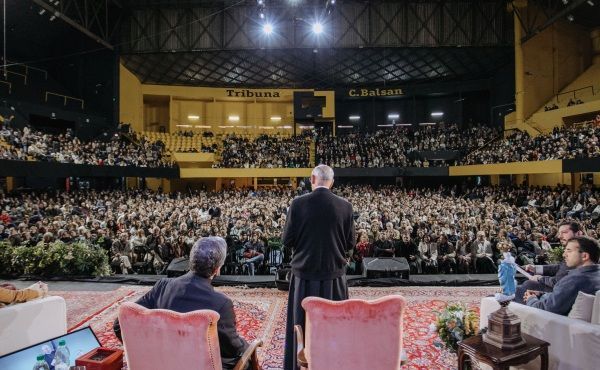
The first to come forward were Emilia, six years old, accompanied by her parents, Renato and Paula, who gave a bouquet of flowers for Our Lady. Renato said that for many years he had lived apart from God, and that it was precisely his daughter who began to bring him back to the faith: "she was my bridge to God," he explained. Building on that experience, he asked the Father how adults can recover that childlike simplicity in their dealings with God.
The Father shared some words of St. Josemaría: "To pray as children pray. To believe as children believe. To hope as children hope." He explained that this spiritual childhood must go hand in hand with great maturity and sincerity with God: presenting ourselves before Him just as we are, with the simplicity of children, and living prayer that way, with complete openness.
Evangelina spoke about Familia sin Barreras, an initiative she runs together with her husband and other married couples to accompany families living in situations of vulnerability. She asked the Father how to speak about God to those who, because of what they have been through, feel abandoned by Him, have lost hope, or cannot even find affection within their own family.
The Father advised asking God for the right words for each person: "Lord, speak through me." He then encouraged getting to know the situation of the person in front of us and, above all, loving them: "The most important thing is to convey warmth, to convey affection. It is a matter of loving." And indeed, he recalled, every person "is worth all the blood of Christ."
There was also a moment to look back on the beginnings of Opus Dei in Uruguay. On the occasion of the 70th anniversary of the arrival of the first members of the Work in the country, to be celebrated in mid-October, former residents of Iará — the first student residence — prepared a video with memories, anecdotes, and testimonies from those early years.
After the video, Luis carried the conversation forward from those 70 years of history toward the future and the road to the Centenary of Opus Dei. At the end, Luis's grandchildren came forward to present the Father, on behalf of all Uruguayans, with an old compass with a sundial, of the kind used by sailors to find their bearings on the high seas. The gift referred to an image St. Josemaría used to speak of Opus Dei as a "little boat." "We want to thank you for continuing to steer this ship on such a good course, with your eyes fixed on the Sun," they said as they handed it to him.

Rosina, from Paysandú, said that in 2007, together with other families, they started a school with the desire to offer a human and Christian formation. In light of the upcoming visit of Pope Leo XIV, she asked the Father how to make the most of that event to renew the faith and help parents take up their role in the Christian formation of their children.
The Father encouraged them to listen to the Pope, taking his words as addressed personally to each one. He also recalled that even in the face of news of wars and suffering in far-off places, we can make those events our own by praying for those who suffer them. On the subject of raising children, he recalled that "what fundamentally forms people is the family." He therefore encouraged parents to take up the responsibility of passing on the faith and to help other families do the same, mainly through personal contact and friendship.
Juan Andrés and Ileana came with their children from Rocha, a city in the northeast of the country about 200 km from the capital. He works in the countryside, far from the city, and said that the distances and schedules often make it hard for him to take part in Mass and other activities that help him grow in his Christian life. He asked the Father how to stay close to God in those circumstances. The Father advised him to do everything possible to take part in the Eucharist and to keep growing in formation, but always with peace, and when circumstances make it impossible, he encouraged him to remember that he is not alone: "God is with you," also at work and in everything he does.

The final questions touched on other aspects of daily life: beauty as a path toward God, friendship, and the challenge of finding a balance between work, family, and other commitments and activities. The Father encouraged them to live with joy: "God wants us to be happy," and to seek a beauty joined to goodness. He also recalled that "true friendship is a form of love." And, speaking of how to order one's time amid so many occupations, he noted: "Family comes first."
Before saying goodbye, the Father once again recalled the upcoming visit of Pope Leo XIV to Uruguay and renewed the request with which he had opened the meeting: "Let us pray hard for the Pope." He then thanked them for their welcome and gave his blessing: "May the Lord be in your hearts, in your families, in your work, in all your intentions, and in your joy."
Monday, August 24
The day began in Casavalle, one of the most vulnerable neighborhoods of Montevideo, where Msgr. Fernando Ocáriz visited the Los Pinos and Los Rosales Foundation, two initiatives born under the inspiration of St. Josemaría that accompany children and young people from early childhood through adolescence, working alongside their families to help them develop their talents and open up opportunities for them to build their own life project.
On arriving at Los Pinos, the Father toured the facilities and greeted the staff and the students he came across, and held a brief meeting with the Board of Directors of the two foundations.
Meanwhile, students, teachers, and other staff member were waiting for him at the gymnasium. As the Father entered, they sang: "I am from the wild shore of murky water and the current, that flows beautifully through its muddy depths," the opening verses of the song Oración del remanso.
Facundo was the first to work up the courage to tell his story. He arrived at Los Pinos this year, after trying to get in for a long time. At first he was afraid he wouldn't fit in, but he soon found teachers and classmates willing to help him. There he also began to learn a little more about faith, he was taught how to pray, and eventually made a decision: to receive Baptism. He asked the Father how he could keep growing in faith and prepare for that moment. Msgr. Ocáriz reminded him that faith is a gift from God that also needs to be welcomed, and encouraged him to ask the Lord for it: "a fundamental point of faith is believing in God's love for us," he explained. Believing that God is with us and loves us, even when we cannot see it clearly.
Luzmila said she arrived at Los Rosales four years ago, after going through very difficult situations during her childhood that had left her sad and very angry with life: "I didn't know what it meant to feel understood and accompanied," she recalled. Little by little she learned to let herself be loved, to lean on others, and also to pray. When she needed a bit of calm, she explained, she would go to the chapel and stay there for a while. "I feel that God helped me see my life differently," she said, before asking the Father how to forgive someone who had made her suffer and how to learn to look at him the way Jesus does.
The Father acknowledged that forgiving is not always easy, and so he encouraged looking at Jesus on the cross, who gave himself precisely in order to forgive us. He also recalled the words of the Our Father: "Forgive us as we forgive those who trespass against us. We ask God for forgiveness, but on the condition that we forgive others," he explained. In those moments when it is hard to forgive, he suggested asking God for help and distinguishing authentic forgiveness, which involves the will, from mere feeling: even if the pain remains, one can decide to forgive and to want the good of the other person. "Forgiving others is something very great," he said, recalling some words of St. Josemaría: "The most divine thing about our life is to forgive."
Gonzalo, a former student of Los Pinos and now sports coordinator, wanted to know what educators and classmates can do to bring the faith closer to young people who still feel distant from it. The Father encouraged him to pray a great deal for everyone: that, he said, is the first step.

As a farewell, the students performed the song Virgen Morenita, and gave the Father a gift on behalf of the institution.
The Prelate then visited Los Rosales. He toured the facilities, greeting families, teachers, and administrators. He also stopped for a few moments to pray in the chapel.
Later, the Father visited the Cathedral of Montevideo. On entering, he came across a group of university students who had come to greet him, and he stopped for a few minutes to talk with them. He prayed at the tomb of Blessed Jacinto Vera, the first bishop of Montevideo. Afterward he shared lunch with the Archbishop of Montevideo, Cardinal Msgr. Daniel Sturla.
The Father at Los Ceibos: "Never give up"
In the afternoon, the Father met with young people at the Los Ceibos sports complex. Amid personal stories, questions, and music, the conversation touched on a wide range of concerns, all close to the hearts and lives of those present: friendship with God, vocation, studies, dating, suffering, solidarity, and the desire to live the faith naturally in the midst of the world.
At the start, the Father encouraged them to strive to be true Christians, knowing that this does not mean being without flaws or limitations, but being willing to begin again and again. He encouraged them to place a personal encounter with Jesus Christ at the center of Christian life, seeking to become more and more like Him. "The Christian life is to follow Jesus Christ. This is the key," he told them. And he suggested a simple path: "To know the Lord, to keep in touch with the Lord, to love the Lord."

He encouraged them to focus their effort without becoming discouraged by difficulties, flaws, or mistakes. "We always have the help of God's grace to keep moving forward, to not become discouraged, to keep fighting." And he explained that our security must rest in God's love for each of us.
Santiago, who has been working at Los Pinos for a little over a year, described how that initiative has helped many families in the neighborhood recover hope. Although today it might seem that everything there "has already been done," he said that those who work at Los Pinos know that "everything is still to be done." So he asked the Father how to pass on to more people the desire to get involved and put their time and talents at the service of others. Msgr. Ocáriz encouraged him to share not only what is done there, but also his own experience. He spoke of communicating, through friendship, what one carries within, because "when there is genuine friendship, what interests one person also interests the other."
Leandro, 24, said that his approach to Opus Dei began unexpectedly while waiting in line to get into a nightclub. There he met a young man who ended up becoming a great friend and invited him to a center of the Work. He drew close to God again and prepared to receive Confirmation. He asked the Father about the importance of formation for growing in one's own faith and being able to pass it on to others. "Formation is necessary so that freedom can be exercised well," explained Msgr. Ocáriz, inviting him to form his intellect in order to be able to recognize the good and choose it freely.

Rafa, a young man from Paysandú, told him that last year he lost his father, who had been working in Venezuela. He remembered him as a very devout man, especially generous with those in need. "Today my life is a mix of joy from the memories I have of him, of the certainty that he is in heaven, but also moments of sadness that he is no longer here," he said. He then asked the Father how to hold on to joy and hope amid the pain. "We are all already praying for your father," the Father told him, and invited him to think of his father's happiness with God: "a happiness so great that we cannot even imagine, the happiness of Heaven." He added: "Heaven is with us, heaven is God. God is also in your heart, and your father is very close to you."
Among other topics, the young people talked about dating, past decisions, the Eucharist, purity, social outreach, and how to share a vocational path with one's own family. Speaking about difficulties and the need to start over, the Father advised them: "Never give up; if you have to start over every day, then start over every day, because God will never abandon us."

Before saying goodbye, the Father gave his blessing, and encouraged them to remain joyful even when difficulties arise: "God is always with us."
Sunday 23 August: the Father meets with families
On Sunday, the Father spent part of the afternoon at La Cantera, a retreat and conference house. He visited the chapel, where he spent a few minutes in prayer and left four roses our Lady's feet: one for each country in the River Plate Region (Uruguay, Argentina, Bolivia, and Paraguay).
During his visit, the Father also planted a tree that will continue to grow and provide shade for the many people who will pass through seeking a few days of formation, recollection, and prayer. After finishing planting the blue cedar, he went over to Wilson, who knows every corner of the grounds well, and told him affectionately: "I'm leaving it in your care. Look after it for me, so it grows well."

Later, the Father took part in a gathering with some families who had come to greet him and speak with him for a few minutes, one by one. Many took the opportunity to ask him for a prayer, share a family story, or tell him about a particular memory. Lucas, one of the children, also wanted to give the Father a gift. He explained simply that his sisters had made drawings for him, but that he himself was not very good at drawing, and so he had chosen to give him one of his toy cars, "the little blue car." At the end, the Father surprised each child with a bag full of sweets.
To close, the Father gave them his blessing, encouraging them to live joyfully and reminding them that, even amid difficulties and setbacks, God is always near.