
📖 ePub ► Magnifica Humanitas
📃 PDF ► Magnifica Humanitas
🎧 Spotify ► Magnifica Humanitas
🎧 YouTube Podcasts ► Magnifica Humanitas
“The magnificent humanity that God has created stands today before a decisive choice: to build a new tower of Babel, or to build the city where God and humanity dwell together.” Thus begins Magnifica Humanitas, an encyclical in which Pope Leo XIV offers a profound reflection on what it means to safeguard of the human person in the time of artificial intelligence.
Faced with rapid technological change, the Pope presents a real choice: Either we allow ourselves to be swept along by the logic of profit at any cost, which can end up dehumanizing us, or we commit to rebuilding the bonds between people and a sense of shared responsibility.
The encyclical is structured in five chapters spanning 245 paragraphs. The letter draws on a wide and rich range of voices: from St. Augustine and St. Thomas Aquinas to Hannah Arendt, Viktor Frankl, and Romano Guardini, as well as Martin Luther King Jr., Wangari Maathai, and St. Laura Montoya. He even quotes from Tolkien’s The Lord of the Rings.
The letter “is not a ‘yes’ or a ‘no’ to technology,” but rather an invitation to ensure that technical progress does not crush what makes us human, recalling that the human person can only be fully understood in the light of Christ.
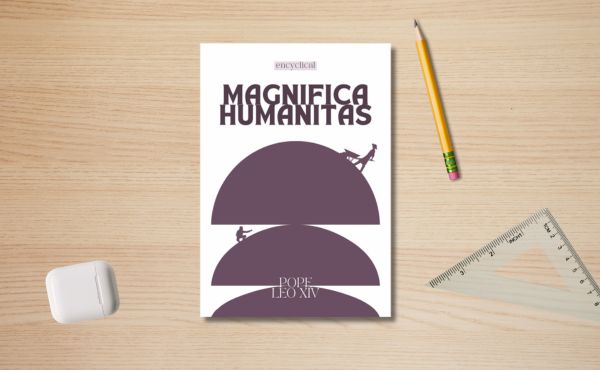
Contents of Magnifica Humanitas
In the first chapter, the Pope emphasizes that the Church’s Social Doctrine is not a static ethical code but a dynamic “legacy of wisdom” that engages in dialogue with the sciences. The Church “does not claim to supplant the responsibilities of politics or institutions, but offers itself as a foundation for collective discernment, helping to recognize and promote whatever serves the dignity of persons, the vitality of communities and the common good” (no. 24).
“Truth is a gift to be shared, not a possession to be monopolized” (no. 25).
In the second chapter, the Holy Father reaffirms that all human coexistence rests on the dignity of the person, which “does not depend on a person’s abilities, wealth or position in life (...). It is a gift that precedes and transcends each person” (n. 50). The encyclical warns that in the digital age the principles of the common good, subsidiarity, and solidarity are essential to prevent new monopolies of data and algorithms that exclude the vulnerable. Social justice, illuminated by faith in Christ, seeks to ensure that the digital revolution becomes a path of integral human development rather than a new source of inequality.
The third chapter, titled “Technology and Dominance; the Grandeur of Humanity in Light of the Promises of AI,” examines the risk of the technocratic paradigm, in which efficiency and control become the sole criteria of value, stripping the person of freedom. Although AI imitates human functions, it lacks moral conscience, a heart, and the capacity to love, and therefore cannot replace human judgment in irreversible decisions.
“The quality of a civilization is measured not by the power of its means, but by the care it is able to offer, by its ability to recognize the other as a face not merely as a function” (no. 114).
In the fourth chapter, the letter addresses truth, work, and freedom, pointing to how disinformation and algorithmic “social control” weaken democracy. The Pope also calls for combating new digital forms of slavery and the data colonialism that exploits the vulnerable.
“Work is not simply an instrument; it expresses and enhances the dignity of our lives. It is a requirement of the human condition, a normal path toward maturity, development and personal fulfilment” (no. 149).
In the final chapter, Leo XIV warns of a “culture of power” that normalizes war and the use of AI in weapons systems. In the face of this trend and the crisis of multilateralism, he encourages us to recover St. Paul VI’s vision of a “civilization of love,” which “is no naïve utopia, but a demanding project, which consists in translating charity into structures of justice” (cf. no. 186). All of us, from ordinary citizens to those in positions of governance, are called to “disarm our words” and to build a peace founded on justice and listening to one another.