Msgr. Fernando Ocáriz, prelate of Opus Dei, is on a pastoral trip through Central America that began in Guatemala City from 4-9 August. He visited Honduras (San Pedro Sula and Tegucigalpa) from 10-12 August, and just concluded the final leg of the journey in El Salvador, from 13-15 August.
You can also follow the trip on our Instagram account.
Photo Gallery

15 August: Second get-together with young people
The final meeting with the Prelate of Opus Dei in El Salvador took place at Colegio Lamatepec. At the outset, the Father reminded them simply of the heart of the Christian life: "It is not just about ideas; it is about someone, Jesus Christ, who knows us one by one and loves us personally."
Neto, who welcomed the Father, recounted with gratitude an invitation he had received some time ago to a workshop at the La Lomita retreat house, and how those days had changed his life. The Father, taking up that sentiment, spoke to them about the importance of giving thanks: "Gratitude is something that transcends us. It is something supernatural: giving thanks to people and giving thanks to God."
Jesús, a student from the first cohort at Colegio Citalá and now an associate of Opus Dei, recalled how he had discovered his path by drawing up lists of pros and cons. For him, the reasons to say yes were beyond counting, yet he was unable to find a single convincing "no." When he raised his uncertainty about how to transform society from within without being dragged down by the negative, the Father gave him a very clear guiding principle: apostolate in the middle of the world is friendship. When the surrounding environment is hostile, we should think as the early Christians did, drawing close to people through personal contact, patience, and much prayer.
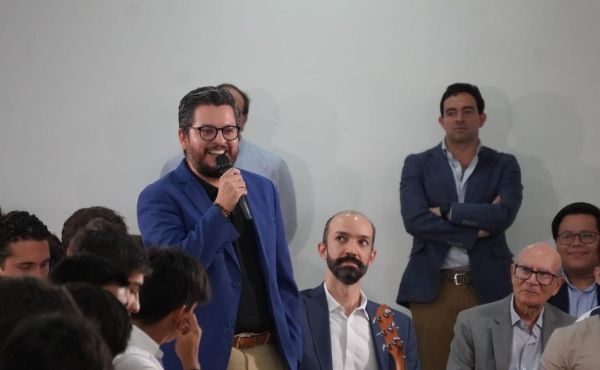
Wenceslao, from the El Molino Cultural Centre in Santa Ana, received the sacraments of Christian initiation at the Easter Vigil this year. "From that day on, I can say that I am a son of God," he said, and he wanted to know how to keep that joy alive every day. The Father replied: "Knowing that you are a son of God brings joy. We are not alone." And to safeguard that gift, he advised him to repeat with confidence: "Lord, I believe that you love me, but increase my faith."
Then Mateo shared a childhood memory of suffering bullying, and how, although he had not felt God close to him at the time, he later came to understand that the Lord had never left him alone. The Father encouraged him to make a positive effort to forgive, explaining that whether or not we do so shapes our very capacity to forgive. "The most divine thing in our life is to forgive those who have hurt us," he added.
The generosity of the young people was evident with Juan Pablo, who recounted that next January he will enter the seminary to discern his vocation, after discovering the great need for priests when visiting communities in need. He asked for prayers for his fidelity, and for those who feel afraid to take the step.
Amid songs and laughter, Jonathan amused everyone by recounting how that morning he had tried to use a free artificial intelligence tool to find pupusa recommendations for the Father, but had been left "talking to himself" because the subscription had run out. Making the most of the anecdote, he asked how we can remain truly human in such a technological age. The Father, smiling, offered him a response both profound and simple: "What technology cannot give you is love." He therefore advised them to "place great value on personal relationships," which technology cannot substitute.
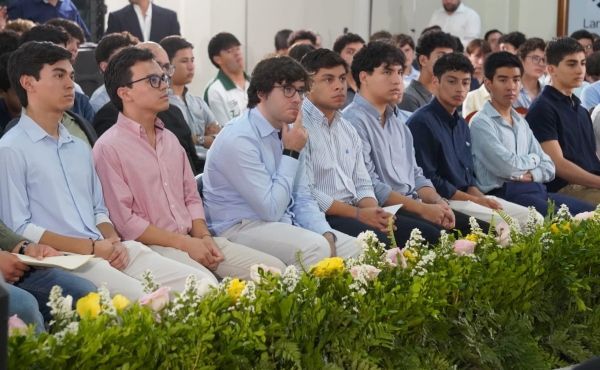
Cecilio, an associate of the Work, presented the Father with an origami torogoz (El Salvador's national bird) and explained its significance: just as paper is transformed into something beautiful when folded with time, patience, and skilled hands, none of us is "merely paper" in the hands of God. It was an image that captured the spirit of the young Salvadorans: how, fold by fold, they wish to let themselves be transformed by God until they discover what He wishes to make of each of their lives.
At the close of the meeting, Justin spoke on behalf of everyone present: "Father, if you could leave just one message for the young people of El Salvador, what would it be?" The response was immediate and warm: "that you pray a lot for the Church and for the Pope." With this important request, and having received his affectionate blessing, a pastoral journey through Central America came to a close.
In the coming days, the Father will remain at the Altavista retreat house in Guatemala, preparing for his journey to Uruguay, which will take place from 22 to 27 August.
Friday 14: Visit to the Siramá Foundation and get-together with young women
On the second day of the Prelate of Opus Dei’s visit to El Salvador, Msgr. Fernando Ocáriz visited the Siramá Foundation, where he took part in a gathering full of personal testimonies. During the visit, he was able to see the work produced by the students and spend some time with the children of the Early Childhood Care Centre (CAPI), who welcomed him by singing a song dedicated to St. Josemaría.
One of the first moments of the visit was the screening of a video about Bishop Javier Echevarría’s visit to Siramá in 2014, in which he expressed his hope that the project would continue growing, through prayer and effort. Reflecting on this reality, Msgr. Ocáriz highlighted the importance of ensuring that the formation and education given in the institution are echoed at home.
The Alas family shared the difficult health experience they went through with their son, a CAPI pupil, and how they found both human and spiritual support at Siramá. The Father reminded them that prayer is always effective and that, even when we do not receive what we ask for, “God is always with us.”

During the visit, there was also time to learn about some of the formation projects. Merlyn presented a dessert prepared by the students in collaboration with a restaurant and shared her own story, telling the Father that, while technical training is important, what she values most about Siramá is the human formation the students receive, because that is the key to bringing about real change in their lives.
Mariely recounted how she came to know Opus Dei in Chile and, after moving to El Salvador, looked for ways to resume contact. Eventually, through her university's social outreach activities, she came to know the Siramá Foundation and, later, discovered her vocation to the Work. “It fills me with great joy to be able to call you Father,” she said.
A former student recounted that years earlier she had lived far from God, caught up in drugs and prostitution. When she came to Siramá, her life changed. She asked the Father how it was possible that God could still love her in spite of that past. Msgr. Ocáriz spoke to her of God’s infinite and merciful love and spoke about the figure of St. Mary Magdalene, beside our Lady at the foot of the cross. He encouraged her to press on and to begin again, as St. Josemaría used to encourage us.
Maria Rosa provides psychological support at the foundation and explained that this work makes her happy, since, paradoxically, by helping others she receives a great deal in return. She asked how to draw on prayer in the course of her work. The Father noted that prayer creates a deep sense of unity and gives us the certainty that God hears and accompanies us, even if we cannot see Him with our eyes.
Two co-workers raised questions about how to pass on faith and love for God in the circumstances of daily life. Msgr. Ocáriz encouraged them to promote a Christian formation that leads people to discover Jesus Christ. He also recalled that learning to love one another and to support each other is a daily task: building unity responds to a great desire of the Lord, “that they may all be one,” as St. John writes in the Gospel.
At the close of the visit, the students performed a song written by Mer and her father, and presented the Father with a gift on behalf of the institution. Msgr. Ocáriz said his farewells, leaving everyone with a wish: “May God be present in all your hopes and dreams.”
A trunk full of stories for the Father
A few hours later, the Father met with a group of young people who take part in the formation and apostolic activities of Opus Dei in El Salvador. The guiding thread of the conversations was a trunk full of objects: a pair of sunglasses, a surfboard, a photograph, an old telephone, a musical score, a rucksack, a telescope, a small stepladder, and even a table leg. Each object served to introduce a story, a memory or a question, and so the family gathering unfolded.
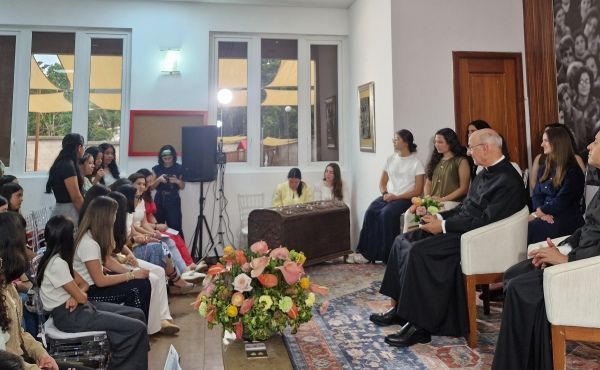
One of the young women recounted that she had had the opportunity to spend time in another country, where she met people with a very different background and way of life from her own. Despite those differences, they came to care deeply for one another and, through them, she was able to discover God’s love. She therefore asked the Father how to grow ever more trusting in that love which God has for us.
The Father encouraged her to draw ever closer to Jesus Christ, especially through the Gospel and the Eucharist. He recommended reading the scenes of the Gospel as if she were one of the characters present, and striving to extend that spiritual life throughout the day, beginning again over and over.
Cami explained that, just as waves can knock a person down and sweep them away, a surfboard helps one to stay afloat. For her, her close friends had played that very role in difficult moments. She therefore asked the Father how she could overcome the fear of speaking about what troubles her.

He advised her to seek out people she could trust and to make use of the means of formation. He recalled the importance of the sincerity that St. Josemaría taught: opening up to others, even when some things feel embarrassing, helps us to receive guidance and also to feel understood.
The main figure in the next contribution was not present. Anto took from the trunk a photograph of Auro, a numerary who had spent many years at the Alamar club and had recently passed away. Anto recalled the friendship they had maintained for many years, despite the difference in age. The two of them shared conversations full of warmth and formation. Auro would tell Anto about how the Work had begun in El Salvador and would advise her on how to be a good person and strive for holiness.
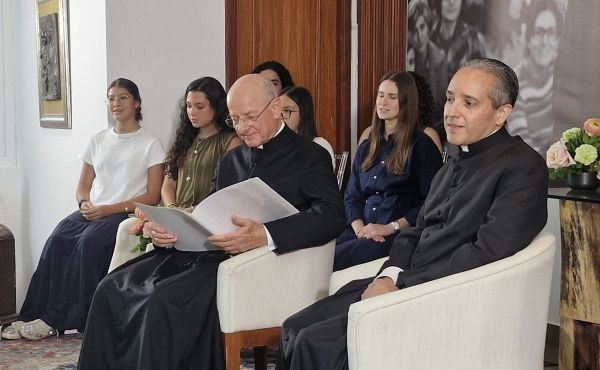
Anto then wanted to know how to remain faithful to God’s plan. The Father explained that the call to holiness is for everyone, but that God makes it concrete in a personal way for each individual. He encouraged her to ask the Lord with courage: “What is it that you want from me?” The answer is discovered little by little, he added, through prayer, guidance, and a sincere seeking of God's will.
The gathering ended with a question about how not to forget, amid the demands of daily life, that we are children of God. The Father recalled that we are never alone: God loves us even when we fail, forgives us and encourages us. “We can always be happy, even when there is suffering; suffering is compatible with the fact that, in spite of everything, God loves us, God is with us,” the Father said.
13 August: Gathering with Families
“Anniversaries are good for remembering and giving thanks.” With these words, Msgr. Fernando Ocáriz welcomed the affection — and a bouquet of flowers — offered by families in El Salvador, who wanted to mark his 55th anniversary of priestly ordination, which falls on Saturday 15 August, ahead of time.
It was the beginning of a gathering where questions and personal stories carried the conversation naturally from one subject to the next.
The first question turned to forgiveness. The Father explained that forgiveness lies at the very heart of the Christian message, for “why did Jesus Christ come into the world? Above all, to forgive us.” On the Cross, he recalled, Christ himself turned to God the Father and asked: “Forgive them, for they know not what they do.” And so, even when an offence stirs anger or rejection, “with our will, we can always forgive.” The feelings, he explained, may take longer to follow, but the will can already make a true decision to forgive.

Stephanie and Sebas, newly married, spoke of their wish to build a home with God at its centre, and asked how they might help other young people discover the beauty of forming a family.
The Father began by posing a more fundamental question: what do we really mean by love? “Sometimes what happens is that people have a very limited — and at times somewhat mistaken — idea of what love is,” he said. It is possible to fall into a kind of “provisional love,” one that lasts only as long as the circumstances remain favourable. But “love, if it is genuine, is for ever.” Nor is it simply a matter of loving the other person for what they give us. “Seeing the other as something that brings me satisfaction,” he explained, “is part of love, but it is not its essence.” That essence lies, instead, in “desiring the good of the other person.”

There was room, too, for a conversation about courtship. Rodrigo, preparing for his wedding to Isabel, asked the Father about that season of preparation. Msgr. Ocáriz encouraged him to live it unhurriedly, making full use of the time to truly come to know one another — not merely by discovering shared tastes or interests, but by confirming that there exists “a harmony in the fundamental ideas of life.”
Herberth, an educator and grandfather, wanted to know how a family might become a true school of virtue. The Father’s answer was simple: “become friends with your children.” Parents, he explained, are not only those who educate or set boundaries; they must also build a bond of trust strong enough that their children feel free to come to them with their problems. “Children must be able to turn to their parents,” he said. And that friendship, more than any lengthy speech, is what passes on what matters most, through the example of life itself.
His answer took on a deeper resonance when Evelyn shared the story of her husband, Edgardo. Diagnosed with leukaemia in 2020, he lived out his illness in close union with God, accompanied spiritually and preparing himself for his final encounter with Him. He died two months after the diagnosis. Two days before his death, Evelyn and her family had received a letter from the Father, written in reply to one they had sent him. Certain that Edgardo now rests in heaven, Evelyn wished to thank the Father for his prayers and asked how she might convey a difficult truth: that Christian joy, too, passes through the embrace of the Cross. His reply was among the most profound of the afternoon: “Despite suffering, and through suffering, we can be happy.”

The Father was careful to clarify that this is not a call to seek out pain. Rather, it is the discovery that suffering can be lived differently once it is united to Christ. He recalled the final years of St. Josemaría, when the founder of Opus Dei, though physically frail and nearly blind, held on to a deep and abiding joy. “How is this possible?” he asked, and answered, “It is only possible through union with the Cross of Christ, through faith.”
He also urged those present to widen their gaze, to make the sufferings of others their own. When news arrives of wars, earthquakes, or other tragedies, it is not enough simply to think, “how sad.” “We can pray a little for those who suffer, even if only for a moment,” he said, building a small but essential Christian habit: to feel what happens to others as very much our own,” whether through prayer for those in pain or by sharing their joy at good news.
As the afternoon went on, the young people and children present shared their own experiences. Mariana, a young girl, described how at school she seeks out Jesus in the oratory each morning, or during break, to tell Him something or to pray for someone in need.
At the close of the gathering, a Venezuelan family who had found their new home in El Salvador gave the Father a photo album of the country that had welcomed them, together with the prayer intentions of several families. The gift is meant to let him carry with him, as they put it, “a little piece of our country.”

Before taking his leave, the Father asked once more for prayers for the Pope: “Above all, pray intensely for the Pope,” he urged them. And so ended a gathering in which families had not only shared their joys and concerns with the Father, but received from him a simple and demanding invitation: to learn to love truly, forgive, walk alongside others, and discover that, even in the depths of suffering, union with Christ makes joy possible.