
August 4 August 5 August 6 August 7 August 8 August 9
Msgr. Fernando Ocáriz, prelate of Opus Dei, is on a pastoral trip through Central America that began in Guatemala City of 4 August and will end on 22 August, after visiting four cities in: Guatemala City, San Pedro Sula and Tegucigalpa (Honduras), and San Salvador (El Salvador).
Photo Gallery

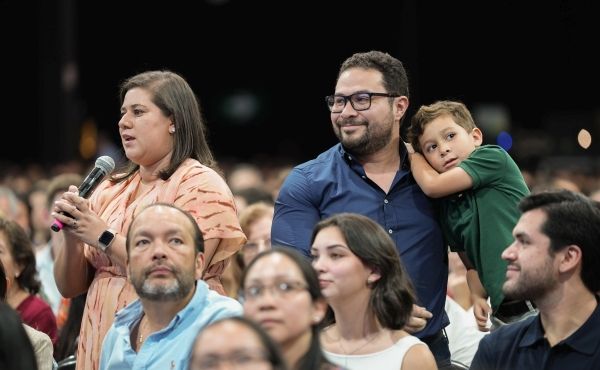
9 August, Gathering with families
In his opening remarks, the Father referred to the Gospel of the day, in which Saint Peter jumps into the water and calls out to Jesus in fear. He encouraged those present to respond to difficulties and setbacks with the prayer, “Lord, increase my faith!”
He invited them to ask God to increase their faith in his love for us, sharing an aspiration he sometimes says: “Lord, I do not understand You,” followed immediately by: “I have no reason to understand You.” Even when we do not comprehend God’s love, he stressed, we can be sure that we are not alone.
Mynor, a paediatrician, shared that he has been married for 30 years and has three children. He spoke about his colleagues’ admiration for Dr. Ernesto Cofiño, not only because of his professional training, but also for his manner with patients and his commitment to helping students and his generous support of various projects. He asked the Father how to achieve the kind of unity of life that allows us to bring family, work and friends to God.
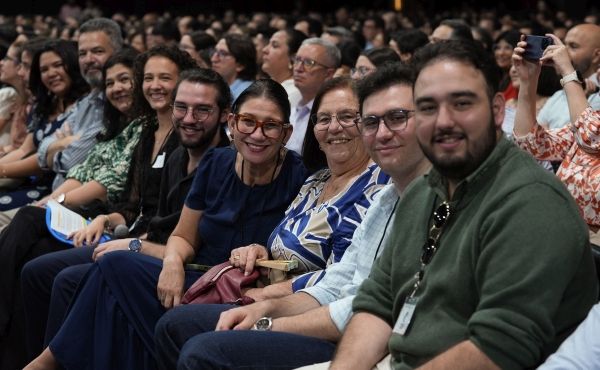
The Father remarked that life has many facets and can at times be complicated, with elements that are even contradictory. “The only thing that can unify everything is love,” because we are always able to love any person, in any circumstance. “The only love capable of unifying absolutely everything is love of God.”
He spoke about St. Josemaría’s suffering — due to physical weakness and the situation of the Church — in the last years of his life. He loved God and the Church so much that he suffered greatly, “but,” the Father said, “we could see that he was happy.”
The Guzmán family, Venezuelans who have been residents of Guatemala for ten years, shared their experience as parents and asked for advice on how to put their love first with so many other things competing for their attention.
The Father reminded them of one of St. Josemaría’s expressions: “Urgent things can wait, and very urgent things must wait.” Having a personal hierarchy of values is helpful in this regard, as is striving to be flexible and understanding that love is what brings order to everything.
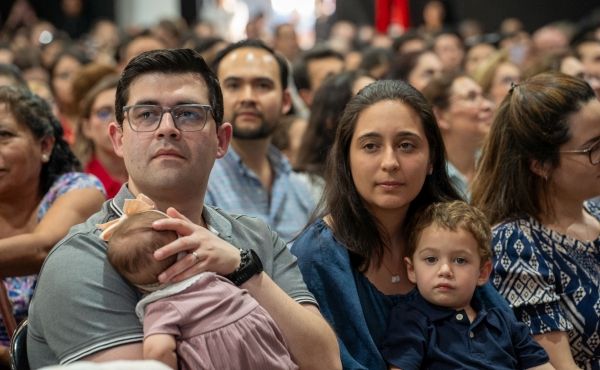
Carlos shared that he discovered St. Josemaría’s writings while searching for words of hope for his mother-in-law during an illness. That was the beginning of a journey of faith that changed his life. He asked how to pass the faith on in the family in a natural way.
“Little by little, with patience,” the Father replied. Children pay close attention to their parents, so it is essential to pass on the faith by example: “Let them see that you love each other. Let them see that you love her, and let them see that everything you do is connected to prayer and to faith.”
Karen said that, since their courtship, she and her husband wanted to have a large family, but God had other plans: they were blessed with their son Juan Pablo and two children who are in heaven.
“A large family is wonderful, but a single child is also something wonderful,” the Father explained, if that is God’s will. He encouraged them to trust in God’s will, which is always the best.
In such circumstances, “an immense field of possibilities opens up” for impactful work and positive influence. Not having children, or having only a few, is also a special calling from God. “It is not a failure; it is a way for you to devote yourselves to more people, so that your marriage, too, may be fruitful.”
Fabiola and her husband waited several years before they were able to have a child. Prayer helped them be close to God in that “impatient” period. They shared joyfully that their son is now a numerary. The Father remarked that vocation is a gift, and that it is important to try to make it easier — as opposed to placing obstacles on the path — for a person who believes God is calling them. He also reminded that that a child and their vocation are a gift to the parents.
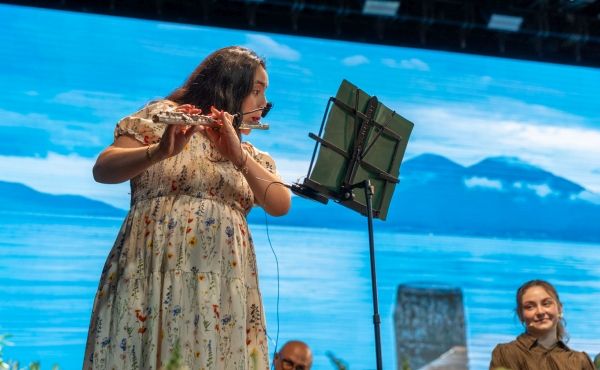
There was music throughout the gathering. Eduardo, a former pupil of Kinal, shared how he first met Opus Dei there. He is currently studying for a degree in music at the Panamerican University in Mexico, and explained that, through music, he got to know Jesus Christ and discovered that He wants to be present on stage too. Eduardo has come to understand this as his mission as a believer.
He then sang a bolero, accompanied by Ricardo on the piano. They performed “Solamente una vez” (“Only Once”), a song St. Josemaría was fond of.
José, from Santa Apolonia Chimaltenango, shared that he learned the value of faith, work and generosity from an early age. On arriving in Guatemala City, he encountered the message of Opus Dei and discovered his vocation as an associate. He asked how to grow in interior freedom so as to respond to God’s will in daily life with greater joy and fidelity.
The Father explained that growing in freedom and growing in love “amount to the same thing.” It is true that we all have real obligations, especially within the family, and freedom does not mean freedom to disregard them. What matters is to fulfil willingly what is obligatory. “When things are done out of love, they are done freely,” he said.
Karina, from Totonicapán, shared her experience as a psychologist accompanying women who haven’t had the opportunity to complete their studies. She has personally seen how, through a variety of training programmes, they discover the dignity of work and begin to feel capable of transforming their reality. Drawing on words of St. Josemaría, she asked how to put the petition, “May I see with your eyes, my Christ, Jesus of my soul,” into practice.
The Father advised her to attend to what the Lord inspires in her, especially in prayer, and to look at people “with warmth, with immense love,” as Christ does.
Praying, “may I see with your eyes,” means, “may I see people with warmth and love.” The expressions of love may differ according to circumstances, but the substance is the same: a desire for the other person’s good.
Joshua, from Nicaragua, currently lives in Guatemala. After spending Holy Week in Rome, he asked various people how they had discerned their vocation, and was surprised to hear that none of them had been one hundred percent certain when they made their decision. Later, this degree of uncertainty became part of his own experience. He therefore asked the Father how to help friends during such moments.
The Father explained that God wants us to have a certain margin —but that it is one of freedom, not insecurity. If He were to reveal his will with absolute clarity, our freedom would be constrained. In this way, we can respond because we want to, not simply because we have evidence.
The Father concluded the gathering by again asking for prayers for the Pope and for civil authorities. He reminded them that praying for those in authority is a very Christian practice.
Finally, he imparted his blessing to the more than 5,000 people present.
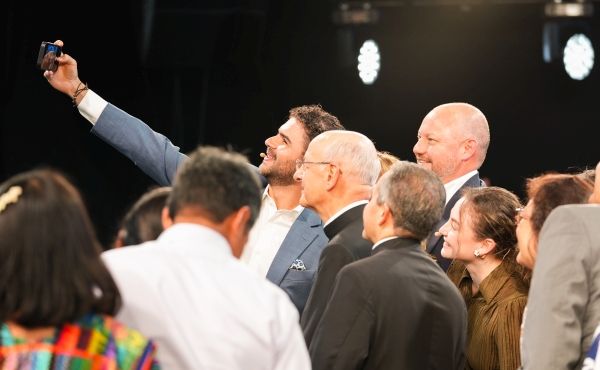
8 August, Mass at the Church of Our Lady Queen of the Family
At the Church of Our Lady, Queen of the Family (Santa María Reina de la Familia) in Guatemala City, on Saturday 8 August, the Prelate of Opus Dei presided at a concelebrated Holy Mass, accompanied by the Regional Vicar for Central America, Fr. Carlos Young, and several priests of the Prelature.
The homily centred on three themes: Christian coherence, the centenary of Opus Dei, and the Virgin Mary’s yes.
“Christ gives our existence its true meaning and shows us the path to happiness in ordinary life (…), because the Lord does not ask us to withdraw from the world, but to find Him and follow Him each day of our lives, knowing that following Him entails a way of living that springs from the Gospel, from trust and faith in God’s love for us,” the Father said, adding that this way of life may sometimes stand out: “Honesty, fidelity, purity of heart, the joy of sacrifice, hope in the face of difficulties... All of this speaks a language that many people appreciate and that many others do not understand.”
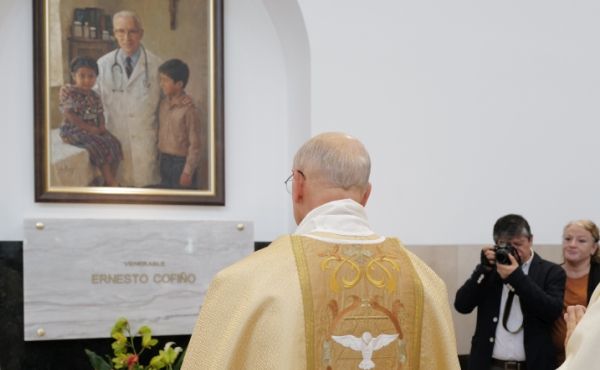
He then took the opportunity to mention Venerable Ernesto Cofiño, a Guatemalan paediatrician and supernumerary of Opus Dei who is in the process of beatification. His remains have rested in this church for a few weeks: “He was a great doctor who sought holiness in the midst of his professional work and family life, attending with competence and care to thousands of children and families,” and his life reminds us that “God’s call is a call of joy, a sign that he trusts in our freedom so that we may bring his love to many other people.”
The Father also took the opportunity to recall the Centenary of Opus Dei. It will be celebrated from 2 October 2028 to 14 February 2030, and those dates are not “as a mere anniversary, but an occasion to give thanks for so many gifts received from the Holy Spirit and to renew our desire to serve the Church better.”
“St. Josemaría dreamed of a world full of men and women seeking holiness in the midst of ordinary affairs; that world remains as relevant as ever! The Church needs Christians who, with simplicity, bring the Gospel to the city, to the countryside, to businesses, to the poor, to culture, through a coherent life filled with the charity of Christ.”
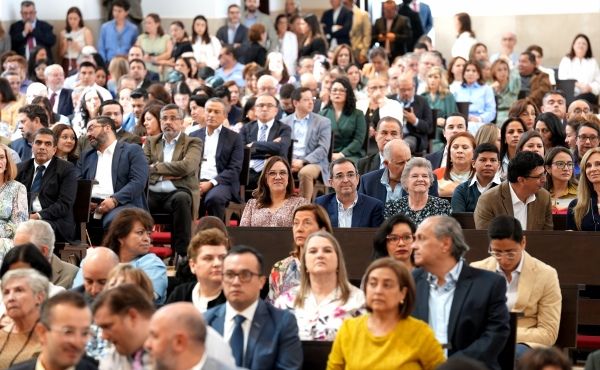
The Father also spoke about the Annunciation of the Blessed Virgin Mary: “The Virgin Mary’s yes continues to illuminate the life of the Church and, therefore, the life of every person, because God continues to call each of us by name: these are his plans of love (…). At the outset she did not know the path when she answered the angel, but it was enough for her to know that God was with her; so too must we learn that God is with us.”
He concluded his homily by entrusting the faithful to the Mother of God: “May Holy Mary, Queen of the Family, teach us to say trustingly each day, ‘be it done unto me according to thy word.’”
The celebration concluded to the sound of the church bells and the Salve Regina.
In the afternoon, the Father went to pray before the patroness of Guatemala, Our Lady of the Rosary, in the Basilica of Our Lady of the Rosary in Guatemala City. He entrusted the apostolic activities the faithful of Opus Dei carry out in the country and throughout Central America, praying especially for the people who form part of the Work and those close to it in these countries.
7 August, Gathering with young people
For an hour, hundreds of young men who receive formation at Opus Dei centres in Guatemala spoke with Msgr. Fernando Ocáriz in an atmosphere of trust, joy and spontaneity.
The Father began by speaking about something we all seek: happiness. To explain it, he drew on point 795 of Furrow: “To be happy, what you need is not an easy life but a heart which is in love.” When a person truly loves, he explained, sacrifices take on a different meaning; their love is born of love for God and leads them to care for others, to serve and help other people encounter God, who is the one who truly makes us happy.
Aarón, from Club Gurkhas, was one of the first to take the microphone, with a concern shared by many: how to distinguish the voice of God amid so many other voices — social media, opinions and distractions — that fill his life and many others’ today.
The voice of God, the Father responded, is heard especially in the Gospel, in prayer and in the Eucharist, as well as in spiritual accompaniment, in which we trust in God’s strength more than our own.
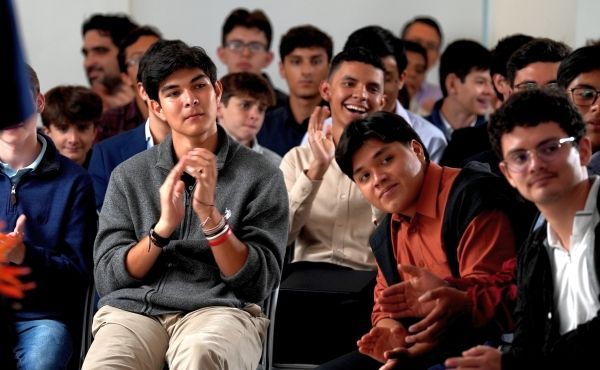
Shortly afterwards, Nicolás, from Club Universitario Balanyá, who has attended formational activities since childhood, wanted to know how to discern his vocation. The answer was straightforward: “We all have a vocation, so the question is not whether we have one, but what it is,” Msgr. Ocáriz told him, adding that discovering one’s personal vocation does not mean waiting for extraordinary signs, since God provides the necessary light for each person to be able to decide freely. He therefore advised going through that process sincerely, going to spiritual accompaniment, and fostering a constant desire to improve.
At another point, Williams, from Club Tucán asked the Father how he had come to know Opus Dei. The Father recounted that he met the Work through his brothers and that, little by little, he drew closer and discovered his vocation.
The conversation continued amid questions, laughter and music. Arber, from Club Nabajal, performed a piece by Bach and asked about finding God through music. The Father explained that all beauty reflects God and that music has a special capacity to lift the soul.
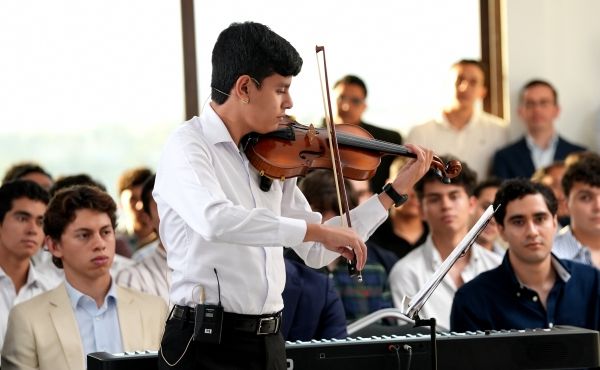
One of the most significant moments of the afternoon came with Carlos, 21 years old, from Jutiapa, in eastern Guatemala. He grew up in an evangelical family and, after finishing school, moved to Guatemala City to study civil engineering. There he began living at the Ciudad Vieja University Residence, where he came to know the Catholic faith through other young people and through the accompaniment of members of Opus Dei. He told the Father that at first his relationship with God was cold and distant, but little by little that friendship drew him closer, until he received classes in the faith and, a year ago, was baptised.
He asked the Father to pray for him so that, if God willed it, he might one day be able to call him “Father” in the fullest sense of the word, and be a good son of his.
But Carlos had prepared something more. He wanted the Father to take with him a memento from Jutiapa, so he presented him with a traditional hat from his homeland. The gesture drew smiles and applause, and the Father, amid the insistence of everyone present, ended up putting it on.

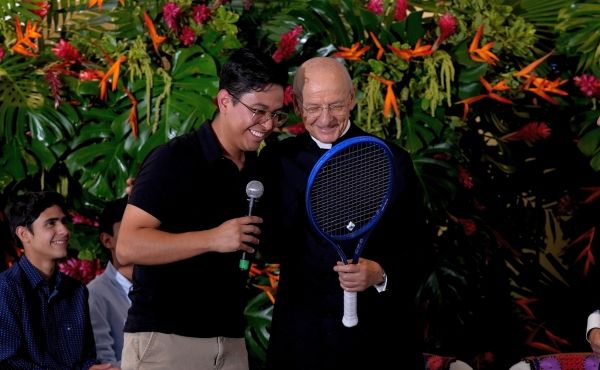
The afternoon continued with another personal story. Before performing a piece on the piano, Julián, who had recently become a numerary, wanted to share that he had something in common with the Father: he is the youngest of his siblings and he loves tennis. The Father then reiterated an idea that had come up earlier: holiness does not consist in having no faults, but in loving and beginning again, continually.
Before the close of the gathering, Alessandro asked what the Father hoped for from the young people of Saint Raphael in view of the upcoming centenary of Opus Dei. Msgr. Ocáriz encouraged them to ask what God wants from each of them and what they can personally contribute to the Work. Preparing for the centenary, he explained, means growing in holiness, friendship, apostolate, work done well and fidelity in small things.
At the end, the young people gave the Father a tennis racket in the colours of the flags of the Central American countries, so that every time he plays, he will remember to pray for the Saint Raphael work.
The gathering ended as it had begun: with applause and smiles, a strong sense of family, and the certainty that, to be happy, what we need are not easy lives but heart that are in love.
6 August, gathering with young people
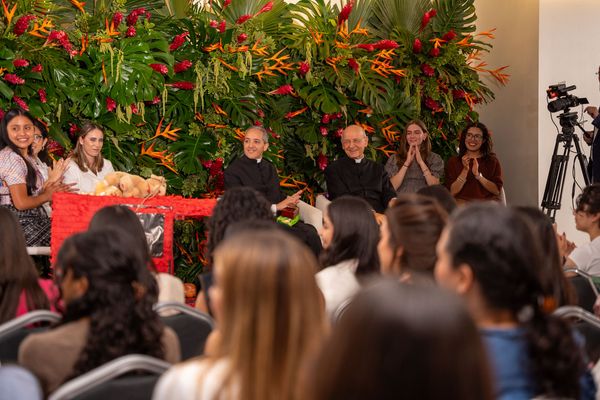
In a warm, family atmosphere, the Father spoke about a wide range of topics, from freedom and fidelity to finding joy amid difficult times.
They welcomed the Father with song “Para aprender a quererte” (“To learn to love you”) by Morat, with ribbons floating in the air and many smiling faces.
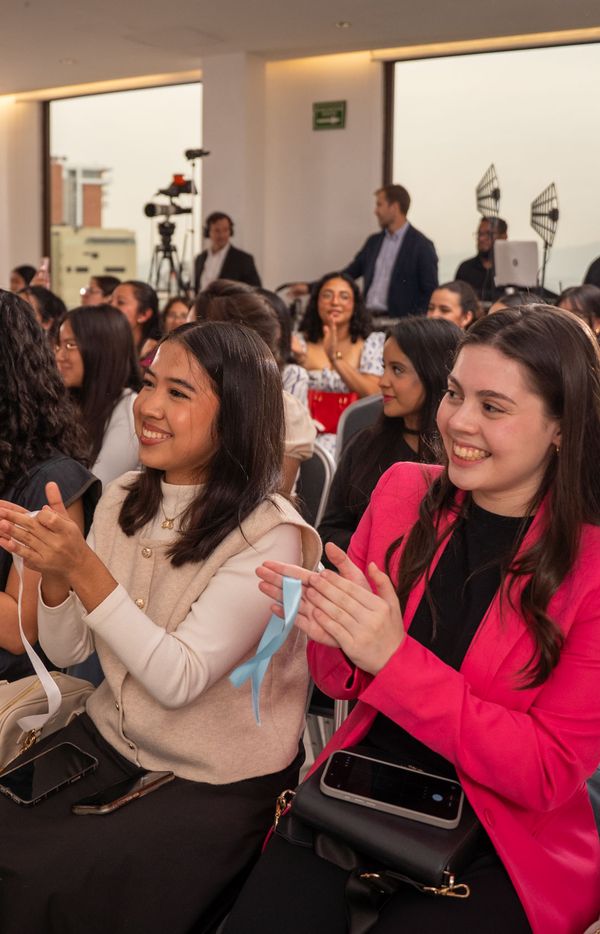
One of the first moments of the gathering involved teaching him Guatemalan expressions. “It is so chilero to have the Father with us today,” Cris said, visibly moved. “Chilero” refers to something lovely, wonderful, or joyful.
Dominique, an architecture student at the University of Istmo (UNIS), opened the conversation by asking how to live a life of service from day to day. The Father explained that, at its heart, service means living as Jesus Christ — who gave Himself on the cross and remains present in the Eucharist — lived, and that the formation offered at the centres of the Work helps toward this.
Emma, Xoxo, and Fer, from the Caranday centre, shared their experience of various activities and asked how to love freedom during adolescence. The Father recalled that St Josemaría was deeply in love with freedom, and explained that true freedom lies not just in choosing, but in loving God. “May you feel truly free in doing what costs you something! It's worth loving what is good.”
Camila, a Salvadoran resident at the Verapaz University Residence, shared that before coming to Guatemala, her happiness depended on the image she projected, but now she has found it in God. She asked how to remain faithful to what God had been doing in her life while continuing to love and stay close to people who live differently. The Father reflected that human strength alone is not enough, and that we need to learn to understand others. He quoted St. Josemaría: “Charity, more than giving, consists more in understanding.” He also encouraged them to love everyone as children of God, without judgment, since only God knows the heart.
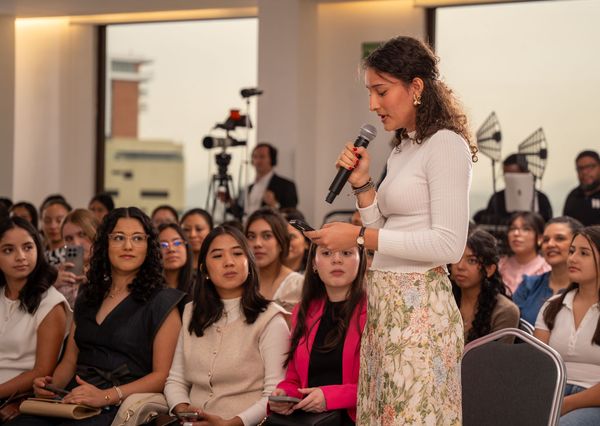
María Inés then spoke. She was a numerary member of Opus Dei for six years, and chose a different path eighteen months ago. She shared that, although she had experienced moments of loneliness, the closeness of many people helped her feel that the Work was still her family. She also mentioned that, through this process, she discovered the value she had simply because God loved her. The Father reminded her that prayer is a great help and encouraged her always to feel very close to the Work.
Victoria, from the Kayac Club, shared her joy in working with primary school girls and their families. The Father encouraged her to see an encounter with Jesus Christ Himself as a child in each of them.
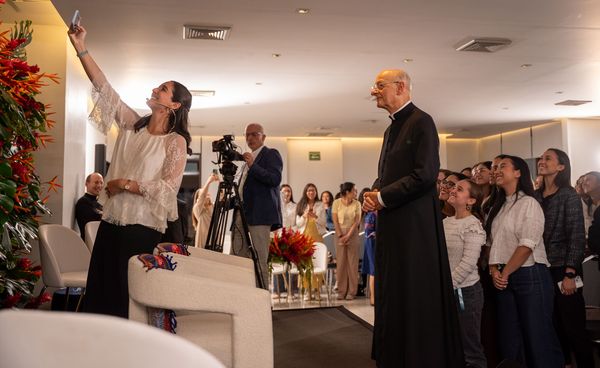
6 August, Universidad del Istmo (Fraijanes, Guatemala)
During an academic gathering at the University of Istmo (UNIS), the Father reflected on the mission of a university inspired by Christian values and encouraged those present to strengthen the unity between faith and reason, always placing the person at the centre of institutional life.
At the start of his address, the Father explained that the Christian identity of a university does not depend solely on its statutes or founding principles, but above all on the lives of the people who make it up.
He encouraged them to keep “the connection between faith and reason” alive, reminding them that “the purpose of the university is developing reason, theoretical, and applied science; and faith is a light that can illuminate the whole of human reality.”
He explained that this identity is not an element “added” to the university after the fact, but must be reflected in the way people work, research, teach and live together in practice. “Christian identity calls for human excellence,” he told them, adding that this aspiration finds its model in Jesus Christ, “perfect God and perfect man.”
One of the themes he developed at greatest length was the primacy of the person.
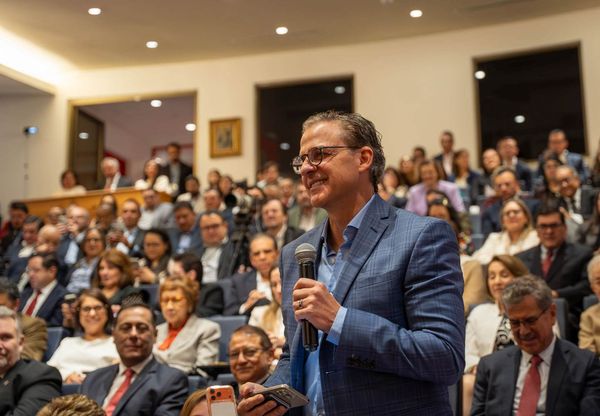
He told them that an essential characteristic of Christianity is the recognition that “the person is more important than the institution.” The latter exists to serve people, and not the other way around; he therefore invited those present to ask themselves constantly whether their daily work truly helps to place people before structures or results.
The Father devoted another part of his address to freedom, noting that every university needs rules, and, at the same time, an authentic atmosphere of freedom.
He encouraged respect for freedom of inquiry and freedom of conscience, values St. Josemaría often highlighted.
He then turned to the exercise of authority, inviting those present always to understand it as a form of service. Authority, he noted, “is for thinking about the good of people,” and not for clinging to office or imposing one’s own criteria inappropriately.
As a practical application, he proposed a personal reflection to those present: “How can we ensure that my activity puts people before things?” and “What does it mean to me today that people are the most important?”
He acknowledged that these are broad and demanding questions, but for that very reason, he invited those present to meditate on them deeply.
The Father reminded them that exercising authority well also means knowing how to pass on personal experience, train successors, and be willing to step aside for others when the moment comes.
In this context he also spoke of collegial governance, which is deeply entwined with the spirit of Opus Dei. He explained that it has a profoundly human foundation: “One person sees less; more people can see more.” Governing institutions requires prudence and the constant exercise of virtues: first and foremost, charity, which means learning to love people, treating them with respect and always seeking their good; and also justice, giving people at least what is fair, and more if possible. “If there is no justice, there is no peace.”
The address was followed by a conversation with several attendees. Bishop Víctor Hugo Palma, Archbishop of Los Altos, Quetzaltenango-Totonicapán, thanked the Father for the teaching he had given and asked how Christians can preserve their identity in daily life. The Father responded that this identity is rooted in a personal following of Jesus Christ and in constant recourse to the sources of God’s grace. It is not simply about pursuing human perfection, but about living out an authentic identification with Christ.
Finally, in response to a question from Ana, a professor in the Faculty of Health, the Father recommended trying to share the beauty of austerity, including through example. He explained that both people and institutions are called to place material goods at the service of others.
“Knowledge for service”
At the close of the gathering, the Father received two gifts from the University: his appointment as Honorary President of the University of Istmo — a distinction he acknowledged by noting that it would be “an occasion to keep you more present in my prayers” — and an embroidered pall.
On behalf of the Board of Trustees, its Chairman, Álvaro Castillo Monge, expressed the gratitude of the entire university community. He affirmed that the visit “encourages us and confirms us as a university on a path we began to walk 28 years ago, and reminds us deeply of our mission: knowledge for service.”
Wednesday, 5 August: gathering with priests
At the Balanyá University Centre in Guatemala City, the Prelate of Opus Dei met with more than a hundred priests, among them Bishop Tulio Pérez, Auxiliary Bishop of the Archdiocese of Santiago de Guatemala. Msgr. Fernando Ocáriz spoke about the way a life of faith helps us to face things with joy, because we know that we are never alone: “St. Josemaría often repeated St. Paul’s words: ‘If God is with us, who can be against us?’” he explained, reminding them that Christ is at once in the galaxies, and also “as close to us as our own hearts.”
He also stressed the importance of always remaining closely united to the Pope and offering our work to Christ. He recalled that “no work is useless” and that we should not be disheartened when pastoral fruits seem to come slowly or even late. “It is worthwhile!” he encouraged them.
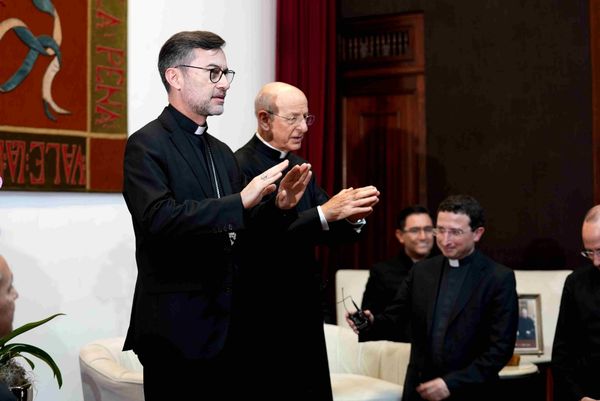
One of the memorable moments of the gathering was when Fr. Luis Felipe, who is from a parish in a rapidly growing area of the capital with many young families, shared that small children, on seeing him, sometimes call out, “Amen!” His story drew laughter from the entire audience. In a similar vein, Fr. Elio, parish priest of the municipality of San Juan La Laguna in the department of Sololá, in western Guatemala, shared his apostolic work with hundreds of indigenous children and invited the Father to “come and see the most beautiful lake in the world, Lake Atitlán.”
Fr. Edgar Iván, from the department of Chimaltenango, asked Msgr. Ocáriz for advice on fidelity and how to accompany seminarians. “Fidelity is a consequence of love; that tells you everything,” the Father said, noting that Jesus Christ wants “the unity among us (priests) to be like the unity of the Trinity (…). We must seek that unity and fraternity, despite having different ideas and different characters. We must be open to everyone, but above all to those who are here, closest to us.”
Making reference to the feast of the day, Our Lady of the Snows, the Father encouraged them to entrust themselves to her through the daily recitation of the Rosary: “She is our Mother, she is our help.”
“Thank you for this wonderful tradition, which St. Josemaría began,” Fr. Julio, aged 86, told the Prelate, thanking him for the visit before asking his to speak a little about the founder’s priesthood. “A great many things could be said about St. Josemaría’s priesthood,” Msgr. Ocáriz responded: “his affection, his love for people, but above all, the centrality of the Eucharist.”
Nearly an hour later, the Father concluded by emphasising the importance of faithfulness, obedience, docility, and collaboration. “We are free. And for that reason, if you wish to be faithful, you will be faithful, because God’s grace is sufficient and his grace is never lacking.”
On Thursday, he will visit the Universidad del Istmo and then, in the afternoon, meet with young students and professionals.
4 August, Arrival in Guatemala City
The Father arrived in Guatemala City this afternoon, beginning his pastoral visit to four cities in Central America.
At the airport, he crossed paths with Cardinal Pietro Parolin, Secretary of State of the Holy See, who was departing Guatemala at the end of a visit to the country, and greeted him warmly.
He later travelled to the Balanyá University Centre, where he was welcomed with great affection by members of the Work. The family of Rodrigo and Tita welcomed him enthusiastically on behalf of many Guatemalan families.
You can also follow the trip on our Instagram account.