
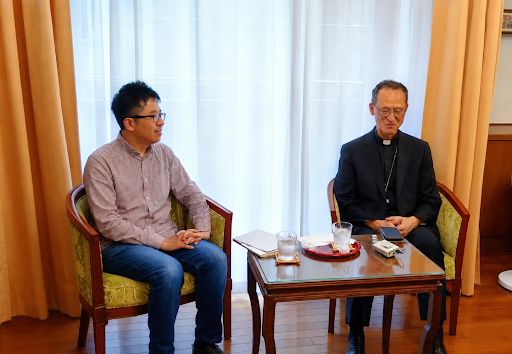
On 1 July 2026, a public conversation was held at Fujimi Academy in Tokyo between film director Jumpei Matsumoto and Bishop Toshihiro Sakai, Auxiliary Bishop of the Archdiocese of Osaka-Takamatsu. Here are some excerpts from their discussion on cinema and the life of faith.
Bishop Sakai is the episcopal adviser to SIGNIS Japan, the Catholic association for communication and media. Director Matsumoto received the Japan Catholic Film Award and the SIGNIS Japan Peace Prize for the movie that he directed, A Mother’s Touch(2022). His recent film,Nagasaki: In the Shadow of the Flash (2025) also received the SIGNIS Japan Peace Prize.
During the conversation, they spoke about living the Catholic faith. Their discussion moved from forgiveness and acting to what it means to become “another Christ.”
On Forgiveness
Matsumoto: Nagasaki: In the Shadow of the Flash is a film about the atomic bomb, and there is a scene in which the characters wrestle with the question of forgiveness. That scene is not based on a historical event. I deliberately added it to the screenplay.
Thankfully, the film has been screened at several educational institutions. At one of those screenings, a student asked me a very difficult question, and I could not give a satisfactory answer. The question was, “Why do we have to forgive?”
That is an incredibly difficult question. It has kept coming up throughout our conversation. If the person asking is a Christian, the answer is simple: Jesus told us to forgive, and that more or less settles it. But when the person is not a Christian, how do we explain why we must forgive? Suppose someone’s parents have been murdered. Would it be wrong for that person to seek revenge? It is not easy to answer.
I could not answer the question myself, so I wanted to ask you, Bishop, what you would say.
Bishop Sakai: It is difficult. Most of the people here are Christians, so for us there is already an understanding that we must forgive. But when we say that we should forgive and then find that we cannot, we are thinking about something very specific: “I cannot forgive this person,” or “I cannot forgive what happened.”
Because we wrestle with the question within ourselves, it is difficult to speak about forgiveness in general terms. In fact, general explanations often fail to reach the person. They may think, “But my situation is different.”
As you said, from a Christian perspective, the answer is simple in a sense. But when a child who is not a Christian asks, “Why do I have to forgive?” it becomes very difficult.
If I were to answer, I would make two points.
The first is that forgiveness frees us from being trapped by the feeling that we cannot forgive. As long as we do not forgive, we can never be free of it. We remain bound to our inability or refusal to forgive.
Of course, there are situations in which it is entirely understandable to feel trapped. In Nagasaki: In the Shadow of the Flash, a character’s mother is killed in a machine-gun attack. The character will never forget that, nor can they ever be free of the fact that it happened. But to that fact, the person adds a refusal to forgive.
The joy and freedom of being released from that refusal can only come through forgiveness. In Christianity, Jesus took everything upon himself and died, freeing us from sin and punishment. We, too, want to become people who are not held captive by these things. That is what it means to be set free.
It is a burden you do not need to carry. Yet it is a burden from which you can be released only by forgiving. I would hope that people could come to see forgiveness as a doorway to something truly wonderful.
The second point is that each of us has already been forgiven many times. Everyone has experienced forgiveness, especially from their parents. Perhaps it is more difficult for someone who has never had that experience at all. But everyone has, in some way, experienced being forgiven.
We may need to search for and recognise those experiences. Because we have been forgiven, we should also forgive. We may think that no one has ever forgiven us, but in reality, people have overlooked our faults and forgiven us many times.
If we want to build a world in which people forgive one another, then forgiveness must begin with us. You could say to the person asking the question, “If that is the kind of world you want, perhaps you could be the first to forgive.”
It might be too simplistic to sum up the state of the world this way, but I think conflicts continue partly because people cannot forgive. Of course, there are situations in which it is entirely natural to feel unable to forgive. Yet by forgiving, we free ourselves from what binds us. If we want to break the cycle of unforgiveness, we can choose to break it where we stand. Then the cycle ends with us.
This is a difficult question, and it can leave you thinking for a very long time. Alongside the question “Why must we forgive?”, there is another question: “Why must we love?” I think the two are connected.
Matsumoto: For Christians, of course, there is Jesus’ new commandment, the commandment to love. So a Christian can understand and accept the answer quite easily.
The idea that forgiveness brings freedom may indeed be the answer. I have also thought about it myself. Suppose human beings possess a conscience, and suppose that conscience comes from God. Refusing to forgive or refusing to love would then mean acting against the very nature of conscience. Perhaps such actions are wrong because they go against the deepest foundations of human nature.
That ultimately leads to a conclusion very close to your first point, that we forgive in order to be set free.
Bishop Sakai: Yes, I think that is right. Christianity, and Catholic theology in particular, would probably say the same. Conscience is given to us by God. It is the most basic expression of the natural law within us: do good and avoid evil. That is why conscience is so important.
Going back to the child who asks, “Why do I have to forgive?”, the very fact that the child asks the question means that somewhere in their heart, they already feel that they ought to forgive. They may say that their parents or teachers taught them this. But the fact that the conviction exists within their own heart means that it is present in their conscience. So I think you are right.
The sense that we ought to forgive creates a dilemma within us when we do not want to forgive or feel unable to do so. Even when the person is someone against whom we desperately want revenge, I think there is still a moment when we wonder, “What would happen if I forgave them?”
The fact that we can entertain that thought, even for a moment, may reveal something essential about what it means to be human.
It feels as though a brighter path opens before us when we consider forgiveness. There is also a particular twist to the Christian understanding of forgiveness.
The twist appears in the Lord’s Prayer. Forgiveness is mentioned when we pray, “Forgive us our sins, as we forgive those who sin against us.”
This means that we must forgive, but notice the distinction. We do not pray, “Forgive us our sins, as we forgive sins.” We pray, “Forgive us our sins, as we forgive people.”
In contemporary psychological language, we are distinguishing between being and doing. We are not asked to forgive the sin itself. We are asked to forgive the person. We do not have to excuse wrongdoing, nor should we. The wrongdoing should be judged by human courts or by God’s judgement.
But we must accept the person, because we are people just like them. This is not exclusively Christian. Parents do the same thing. They scold their children when they do something wrong, but they do not reject the child. In fact, they become angry precisely because they do not reject the child. They are saying, “I love you, but you must not do this.” Their love does not disappear because the child has done something wrong.
That is what God asks of us. We are required to forgive the person, not to declare that the wrongdoing itself is acceptable. If we do not make that distinction, forgiveness becomes impossible.
We do not have to excuse the crime. But the person who committed it also has a history and circumstances into which they were born. Of course, if they freely chose to commit the crime, they are responsible for that choice. Yet we can still search for reasons that help us understand them, just as parents look for explanations when their child does something wrong.
A parent might say, “My child did something bad, but that friend led him into it,” or, “My child has always been weak. He was afraid.”
Parents instinctively look for something that might speak in their child’s defence. We can do the same for anyone. This is precisely how God looks at us. So it is important to distinguish exactly what it is that we are being asked to forgive.
In English, there are the words forgive and pardon. They come from the same idea. Pardon comes from the Latin perdonare. Per corresponds to for, and donare means to give.
To forgive, then, is to give oneself. Forgiveness means giving to the other person the self that wants things to be a certain way. And giving oneself up in that way is a form of liberation. It is like saying, “I hand this over to you. Do with it as you will.”
On Acting and Becoming Christ
Matsumoto: I understand. Thank you.
May I ask my last question? Since I am a director, I have a deep interest in acting. Every day I think about what allows an actor to give an outstanding performance.
The usual assumption is that great actors perform well because they have been trained. But at one point, I began to think that this could not be the whole explanation.
I do not know how many people here watch a lot of films, but sometimes a completely untrained person gives an extraordinary performance. Films often cast children who have never acted before, but sometimes adult non-professionals are cast as well. And every now and then, they give a truly remarkable performance.
When such a performance is captured on camera, you begin to realise that while acting skills can certainly be developed through training, there must ultimately be something more, something that technique alone cannot explain.
I have begun to think that acting may be about rapport. Rapport is a term from psychology describing the close relationship established between a psychologist and a client.
First, the actor becomes close to the character. Second, the actors playing the different characters become close to one another. If those two forms of rapport are established, perhaps a remarkable performance becomes possible.
The clue that led me to this idea was prayer. From time to time, though not very often, I think and pray about how one becomes another Christ.
It seems to me that becoming another Christ has something in common with acting. Perhaps the first step is to become close to Christ. Then, if you are carrying out apostolate, perhaps you must also become close to the person you are trying to reach. What you have received can then overflow through the vessel of your own self.
I call this my “rapport theory.” It may sound simple, but it is actually quite difficult. It requires patience and a great deal of preparation.
To skip over many of the details, I believe that self-disclosure is essential to this theory. It is similar to forgiveness, in the sense of offering oneself, of giving oneself. Self-disclosure can be very difficult, so I would like to ask what you think about it.
Bishop Sakai: Let me think. As you said, rapport is the close relationship between a psychologist and a client. Such a relationship could not exist without self-disclosure. The same would be true of any relationship of trust.
An actor naturally enters into a role, but the actor’s own self remains present. There are two people involved, in a sense: the actor and the character. I find that relationship fascinating.
On Relationship with God
Matsumoto: If I may clarify, I actually ask actors to abandon the idea of completely becoming the character. It is impossible to become the character because the character is a different human being. I tell them, “You cannot do it, so please do not try.”
Instead, I ask them to reveal or offer the elements that make them who they are to the character they are playing. I ask them to give themselves to the character. In return, I ask them to receive what the character has to offer.
Above all, I ask the actor to become the character’s closest friend. Once they have become close friends, the actor can portray that person in a particular situation while experiencing something very similar to what the person would feel.
So rather than trying to become the character, the actor surrenders the self. When this happens, the actor’s own personality emerges very strongly on camera. At the same time, the distinctive personality of the character also emerges.
I may want to become another Christ, but I can never become exactly like Jesus. Yet by offering myself to him and receiving him into my own heart and body, I can live my daily life both as myself and, at the same time, as Jesus.
Bishop Sakai: Jesus himself says, “I no longer call you servants. I call you friends.” That is an important point.
In our relationship with God, Jesus Christ does not treat us as servants, nor even simply as students with a teacher. He calls us friends. Although the distance between God and ourselves is infinitely greater than that between a teacher and a student, Jesus nevertheless says, “You are my friends.”
If he calls us friends, it would almost be discourteous for us not to regard him as our friend in return. I do think we are called to enter into precisely this kind of relationship of rapport with him.
In prayer, we reveal ourselves to God. That is one reason prayer is so important. We have that time every day in which we show ourselves to God, and in a sense, God also reveals himself to us. There is mutual self-disclosure, and a relationship is formed. That is profoundly significant.
Matsumoto: Apart from prayer, are there other moments in which God and the human person reveal themselves to one another?
Bishop Sakai: Music, for example. This can happen through hymns, but also through art more broadly. Art can become something that takes place between the human person and God.
A Christian artist naturally places something of that relationship into the work. And the person who encounters the work also receives something from it. I find that deeply fascinating.