

It is the month of May once again, when the Church turns her gaze toward the Blessed Virgin Mary through Marian processions and pilgrimages to Marian shrines.
In the Philippines, this Marian Month is marked by the Flores de Mayo, where flowers are offered daily to Our Lady in acts of devotion and love. May is also Fiesta Season, when towns and provinces come alive with celebrations that blend faith, tradition, and communal identity. Among the most beloved of these is the Santacruzan, a procession of women dressed in historical gowns representing Marian titles, virtues, and Biblical queens. The procession culminates with Reyna Elena, or St. Helena—the mother of Emperor Constantine—reenacting the discovery of the True Cross.
Beyond these well-known festivities, however, one celebration has always held a special place in my heart: the Kneeling Carabao Festival in my hometown of Pulilan, Bulacan (Philippines).
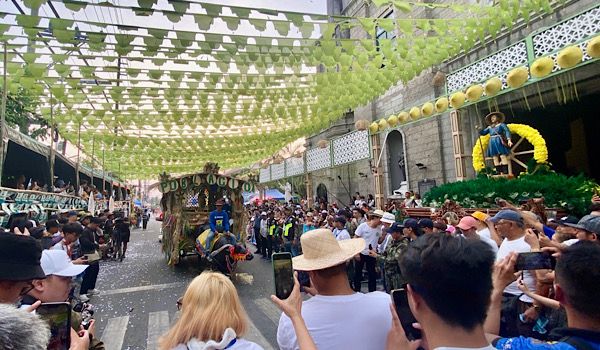
Held every May 14, on the eve of the feast of San Isidro Labrador (St. Isidore)—the patron saint of farmers—the festival gathers farmers from different barrios (communities) who parade their carabaos through the Poblacion, the town center where the church, municipal hall, plaza, and local establishments stand. The carabaos pull carts adorned with colorful barrio themes and displays of harvest abundance.
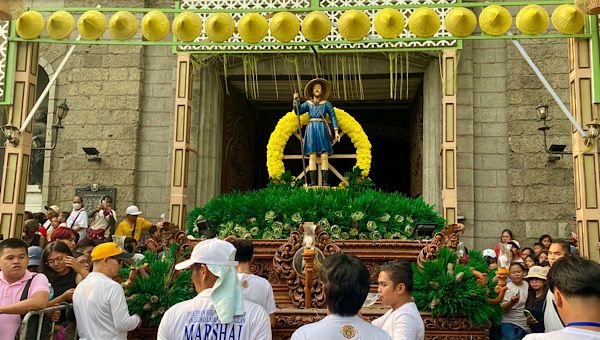
When they reach the front of the church, each cart pauses and the carabaos kneel before the image of San Isidro Labrador as a gesture of thanksgiving for a bountiful harvest.
As a child spending summer vacations in Pulilan with my family, I vividly remember how the entire bayan (town center) transformed during the fiesta. The streets would fill with music, movement, and people gathering in excitement as garland-adorned carabaos took center stage.
As each carabao with its cart arrives at the church façade, the crowd would shout in unison: “LUHOD!” (“Kneel!”)—and the carabao would slowly bow and bend its front knees.
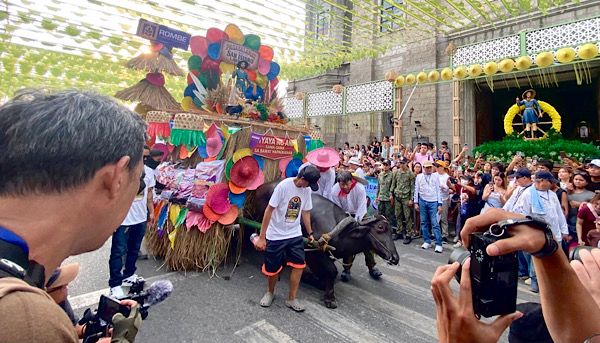
As a kid, I saw it as an amusing and colorful summer celebration. Only years later did I realize that what unfolded before me was far more profound than spectacle or entertainment. It was a language of gratitude shaped by labor—an embodied prayer that transcended words and spoke directly to the heart.
The kneeling of the carabaos remains deeply etched in my memory. It is more than symbolic. It expresses a quiet but powerful conviction: that work, when done well and offered generously, can become an offering to God. The gesture is simple, yet it carries an entire worldview—that labor is never merely self-contained, but open to grace, thanksgiving, and transcendence.
Over time, I came to see how this resonates deeply with the teachings of St. Josemaría Escrivá, the founder of Opus Dei, who emphasized the sanctifying value of daily work. In The Forge, he writes: “You have to work with such supernatural vision that you let yourself be absorbed by your activity only in order to make it divine. In this way the earthly becomes divine, the temporal eternal” (The Forge no. 730). Seen through this lens, the kneeling carabao becomes an image of work offered and work transformed.
St. Josemaría often reflected on the donkey as a symbol of humble and faithful labor: quiet, steady, unassuming, yet persevering in its task. In many ways, this image finds a natural reflection in the carabao—the Filipino beast of burden. Both the donkey and the carabao embody silent endurance, strength, service, and perseverance.
As an aspiring writer, historical reenactor, heritage advocate, researcher, and master’s student, I spend much of my time reading, writing, studying, and engaging with the past in search of meaning. My pursuits may not be extraordinary, yet they require fidelity, patience, and care.
In many ways, we are all like those carabaos.
Like them, we carry unseen burdens. Like them, we move through repetition and responsibility. And like them, we are invited to recognize that what we carry each day can be offered to God.
Again, St. Josemaría expresses it beautifully: “You should maintain throughout the day a constant conversation with Our Lord, a conversation fed even by the things that happen in your professional work. Go in spirit to the Tabernacle… and offer to God the work that is in your hands” (The Forge no. 745).
For me, the Kneeling Carabao Festival endures not merely as a cultural tradition or childhood memory, but as a profound reminder that ordinary labor—when lived with faith, gratitude, and perseverance—can kneel before God in its own way, and in doing so, become prayer.
Opus Dei is an institution of the Catholic Church that helps people in all sectors of society find God in ordinary work and daily life, while serving the needs of the Church and the common good.