In his opening remarks, commenting on the Gospel of the day’s Mass, the Prelate encouraged those present to lean on Christ in times of difficulty: “Without Him we can do nothing, but we always have his strength, his help. We are never alone. We can never think that the demands of Christian life, work, and family are beyond us. Sometimes they are beyond us humanly, but with the Lord, we always have strength.”
He also spoke about the Holy Father’s recent trip to Spain, encouraging everyone to be close to him, above all through prayer: “Just think of the enormous work he has before him: the whole Church and the whole world, because the Church exists for the world. And nothing can be foreign to us either, especially war and the sufferings of so many people now.”
As is customary at these kinds of gatherings, which have a festive and family-like tone, several people told the Father how they are trying to improve their Christian life and asked him for advice on getting involved in projects for evangelization.
Pope Leo XIV’s visit to Spain last June and preparations for the centenary of Opus Dei came up again and again. In fact, the first contribution to the get-together addressed the milestone date: Ana, a researcher at the University of Navarre, asked Msgr. Ocáriz how to prepare for the hundredth anniversary, with an eye to the early members of Opus Dei.
He responded by emphasizing the central role of the people of the Work from every era, not only the ones chronologically closest to St. Josemaría: “We are all on the front line. We cannot think of the ‘first ones’ as belonging to some heroic era in the past, above all because we are always contemporaries of Jesus Christ, who is the fundamental cause of everything. Without Him, no institution would be of any use.”
He encouraged the members of Opus Dei to embrace their vocation with a grateful and active attitude: “Take it as something very much your own; we should not simply think, ‘I am in the Work,’ but rather, ‘I am the Work.’”
The musical part of the event was provided by the choir of the Colegio Mayor Goroabe in Pamplona, which performed various songs, including “Eso que tú me das,” by the Spanish band Jarabe de Palo.
The directors of two initiatives that support families and young people were able to explain their projects to the Prelate: from Bilbao, María Eugenia, director of the Arangoya profession training center, told him that they celebrated their 50th anniversary this year, expressing her joy at the journey they’ve been on so far and the bright future ahead, as professional training is a field very much in demand today.
Ainhoa, a volunteer with the Lagundu Arakil association in Burlada, also shared some details of the social and cultural work carried out there over more than thirty years to provide comprehensive formation for families and academic support for children, many of whom are at risk of exclusion.
A touching moment of the gathering was the story told by José María, a state lottery and betting shop vendor from Pamplona, whom St. Josemaría once held in his arms as a baby and who has since come to know all of his successors at different points in his life. He asked the Father about the importance of Christian formation for growth in the day-to-day.
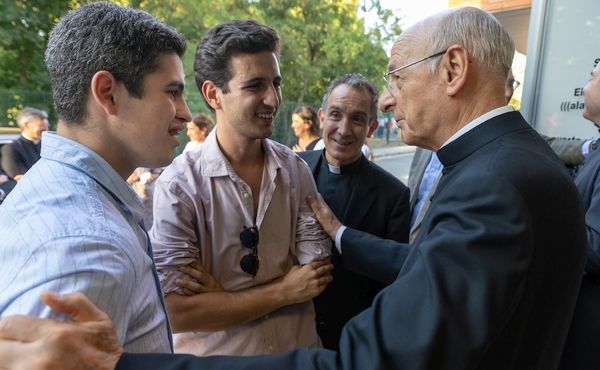
Msgr. Ocáriz stressed that formational activities are always necessary, because their purpose is “to identify ourselves with Jesus Christ.”
“We need formation,” he said, “in order to form Christ within us. That is why it never ends. We never say: ‘I have already reached the maximum, I no longer need to grow in formation.’ There is always room for improvement; that is why we make use of the means of formation: to be more closely united to Christ.”
There were a few other questions and stories throughout the hour-long gathering. Msgr. Ocáriz also asked those present to accompany him in prayer for his upcoming trip to Guatemala, Honduras, El Salvador and Uruguay, which will take place in August.