

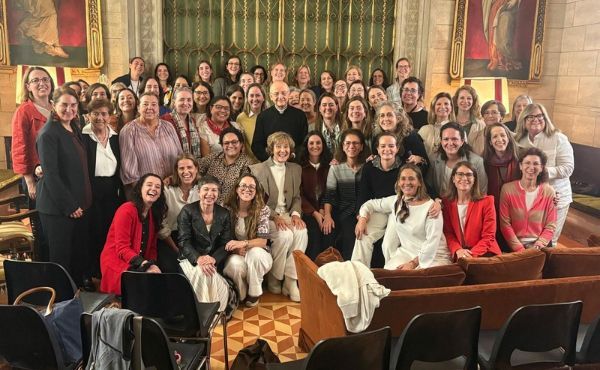
Fifty-five nurses from Argentina, Austria, Brazil, Colombia, Congo, Spain, Italy, Mexico, Portugal, and Puerto Rico gathered for four days near Castel Gandolfo, about 25 kilometers southeast of Rome, to take part in a workshop for women in nursing. Entitled, "Being a Nurse Today," it was a time for reflection on the value of care, the dignity of the person, and a profession that unites scientific expertise, ethical responsibility, and human passion.
The initiative, sponsored by the Oikia Foundation with the support of the School of Philosophy at the Pontifical University of the Holy Cross, featured experts, nursing directors, and frontline nurses and addressed professional identity and responsibility, leadership, the humanization of care, artificial intelligence, the ethics of caregiving, the well-being of caregivers, work-family balance, and emotional intelligence.
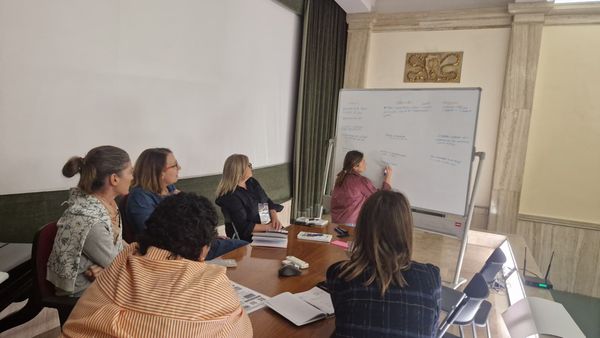
A dialogue born of international experience
"It all began with a conversation among nurses from several countries about the dreams, challenges, and needs of our profession, seen in light of the spirit of Opus Dei," explains Anna De Benedictis, PhD researcher in Nursing Science at Campus Bio-Medico University of Rome and a member of the organizing committee. "Together with Consuelo Diez, of the Austral Hospital in Buenos Aires, we drafted a very simple proposal that, within a few months and with the help of many people, became a reality. And that reality was even greater than we could have dreamed!"

Nursing today, from Italy to Congo
Nursing today is undergoing profound change: new health needs, an increasingly aging population, technological advances, and artificial intelligence. Rather than simply asking what a nurse does, we need to understand what caregiving truly means and what caregivers themselves need in order to keep doing it well.
"Being a nurse today calls for study, competence, and ongoing education to respond to the population's changing health needs," explains Anna De Benedictis. "At the same time, it calls for balance and an all-round growth in human and personal virtue, so as to keep finding the strength to do one's work with renewed meaning and motivation each day. I believe this is possible through prayer and through the desire to see God in all things and in every person."
The meeting offered a chance to compare very different realities, including differing degrees of recognition for the profession. "In the Congo, nursing still carries little prestige," says Candela Varela, a nurse at Monkole Hospital in Kinshasa. "That's why, at our school, we place such emphasis on training our students, so that they can grow as professionals and as people, and care for their patients ever better.
"I've lived through things that have marked me deeply. I once helped arrange for two very ill Congolese children to travel to Spain for treatment: one was cured of a tumor and was able to return home; the other died on the journey back. But the most remarkable thing that ever happened to me was when I came down with malaria and it was my own students who cared for me. Sometimes, from the pain, I would ask them not to touch me, and they would tell me, 'You're the one who taught us to do this. Let us take care of you now.'"
Artificial intelligence and the philosophy of care
In an age marked by rapid technological progress, it is essential that care remain authentically human. Drawing on Pope Leo XIV's encyclical Magnifica Humanitas, the workshop reflected on how AI is making inroads into clinical work, and highlighted the dignity of the person, the relationship between nurse and patient, professional responsibility, and the deeper meaning of service in nursing.
"Artificial intelligence is a valuable tool in the service of people," Anna De Benedictis points out, "but it is only truly useful insofar as it helps the human person flourish. Can it replace the nurse? Absolutely not: nursing is a profession built on care and relationship. A robot may be able to perform certain tasks, but it can never provide true, caring attention."
"We nurses need to keep pace with the times and make the most of the opportunities technological progress offers us," adds Giulia Piccoli.
The underlying reflection was offered by Elena Colombetti, professor of Ethics at the School of Philosophy of the Pontifical University of the Holy Cross, who focused on the anthropological dimension of the profession: "Care is not some exceptional condition of human existence; it belongs to our very makeup. The way a human being exists in the world is through care: receiving it, and offering it to others. That is why the healthcare professions lie at the heart of something constitutive of human relationships. And in caregiving, what matters is not only the outcome but the process itself; otherwise we risk losing sight of the person in front of us, here and now."
Msgr. Luis Romera, former rector and professor of Metaphysics at the same university, drew on St. Josemaría's own experience alongside the sick to illustrate the human and spiritual richness of the profession. Starting from unity of life, magnanimity, and ongoing formation, he proposed that professional commitment and interior life nourish one another. In this light, even the most ordinary gestures of caregiving take on a deeper meaning: caring for another becomes the concrete expression of a dedication that unites competence and a spirit of service, action and contemplation.

Balancing work and family
Balancing family and professional life is a major challenge for any woman, but it takes on a particular character for nurses. Prof. Paola Binetti, professor of the History of Medicine and a child neuropsychiatrist, put it this way: "A nurse brings with her a wealth of competence and a particular sensitivity to caregiving, which often makes her a point of reference within her own family as well, especially when someone falls ill. This puts her at risk of running out of time for herself: time meant for her alone ends up being given over entirely to everyone else.
"Often the outside world, even while admiring and valuing her work, asks of her an availability and self-giving that go beyond what is reasonable. We need to recognize the worth of her work without forgetting that she is, above all, a person, entitled to care for her own health, pursue her own interests, and devote time to herself. Being a nurse is a hugely important part of who she is, but it doesn't define the whole of who she is."
Giulia Piccoli offered a concrete example: "I'm a nurse on a hospital ward and the mother of two children. Balancing work and family, especially with night shifts, isn't easy. When my children are sad because I have to go to the hospital, I explain to them that mommy is going to take care of sick people. One night, it filled me with joy to hear my four-year-old son tell me, 'Mommy, while you're at work, I'm praying for all your patients.' One day, a patient was feeling very discouraged, and to cheer her up I told her, 'My son is praying for you at home.' Being a mother helps me care for my patients with greater attentiveness and tenderness, and I hope to pass on to my children the value of work and the importance of doing it well."
The workshop offered an occasion to pause and rediscover the value of the nursing profession in all its dimensions: scientific, professional, human, cultural, international, vocational... It is a profession that can also become a path to sanctity in everyday life.
As the nurse Elisabet Argemi, of the Hospital Clínic de Barcelona, recalled, quoting St. Josemaría: "Children. The Sick. — As you write these words, don't you feel tempted to use capitals? The reason is that in children and in the sick a soul in love sees Him" (The Way, no. 419).